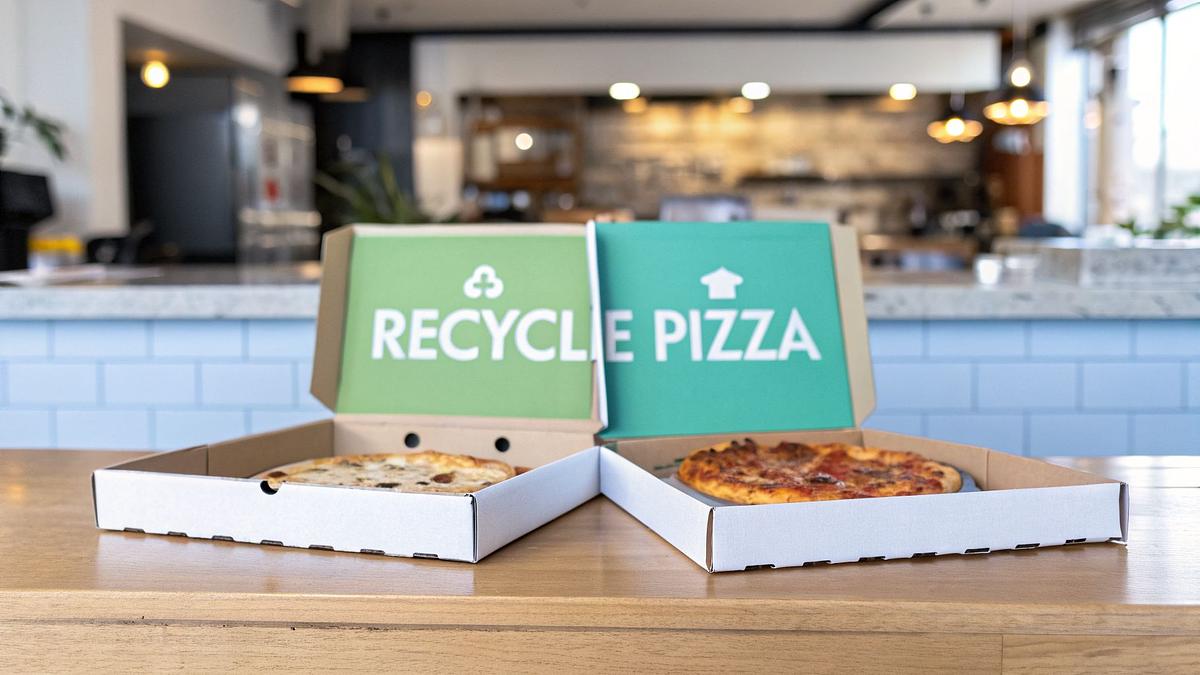
So, can you recycle pizza boxes? It’s a question we hear all the time from UK food service businesses, and the straightforward answer is yes... but with a very important catch. The box has to be clean. While the cardboard itself is a perfect candidate for recycling, it's the grease, cheese, and leftover crusts that throw a spanner in the works.
For any hospitality business—be it a restaurant, takeaway, or café—navigating packaging sustainability can be a challenge. Making the right choices not only benefits the environment but also enhances your brand's reputation and can even impact your bottom line.
The Simple Answer to a Greasy Question
For any restaurant, takeaway, or café serving pizzas, that cardboard box is a constant source of confusion when it comes to sustainability. On one hand, it’s made from corrugated cardboard — a valuable material that recycling plants are eager to get. On the other, its journey is often cut short by contamination.
Think of it like this: oil and water don’t mix. The same principle applies when turning used paper back into pulp. The grease from a pepperoni pizza seeps into the cardboard fibres, and once it's there, it can't be separated. This contamination can ruin an entire batch of recycled paper.
This is where the confusion really kicks in for food businesses. You might see big chains claiming their boxes are 100% recyclable, but then your local council or commercial waste collector refuses to take them. They’re both right, in a way. The box material is recyclable, but once it’s greasy, it’s just waste.
The core principle is actually very simple: clean cardboard is recyclable; greasy cardboard is not. Getting this right is the first step to making a real difference in your business’s waste management and showing customers you’re serious about sustainability.
This flowchart breaks down the decision-making process. It really is as simple as checking for grease.
As you can see, the presence of food and grease is the only thing that stands between the box and a new life as a recycled product.
Smart Packaging Choices Make a Difference
The good news is you can tip the odds in your favour right from the start. Choosing the right packaging isn’t just about making your food look good; it's a strategic move that directly impacts how sustainable your operation can be.
Here’s what to think about:
- Material Quality: It pays to invest in high-quality kraft pizza boxes. Their dense, sturdy construction is naturally more resistant to grease, meaning less saturation. This keeps more of the box—especially the lid—clean and ready for the recycling bin.
- A Broader Mindset: This thinking shouldn’t stop at pizza boxes. Applying it to all your disposables, from recyclable cups and food containers to paper napkins and biodegradable straws, makes a huge difference. Better materials almost always lead to better recycling outcomes and demonstrate a commitment to eco-friendly practices.
By being deliberate with your packaging choices, you lay the groundwork for a much simpler and more effective recycling process for your staff and your customers.
Why Grease and Cardboard Don't Mix in Recycling

Ever tried washing a really oily pan with just water? You know how the water just beads up and the grease stubbornly stays put. That’s pretty much the core of the problem when a recycling plant tries to tackle a greasy pizza box.
To recycle cardboard, it gets thrown into a giant vat of water and churned into a thick, soupy mixture called a slurry. This pulp is then cleaned, screened, and pressed into new sheets of paper or card. But when grease and oil get into that mix, they cause chaos.
Just like in your washing-up bowl, the oil doesn't dissolve. Instead, it clings to the paper fibres, creating oily spots throughout the slurry. When this contaminated pulp gets pressed into new paper, those greasy patches create weak spots and holes, rendering the final product completely useless.
The Domino Effect of Contamination
The real kicker is that it’s not just one box that gets ruined. A single, heavily soiled pizza box has enough grease on it to contaminate an entire batch of otherwise perfectly good, clean cardboard. When a recycling facility spots this kind of contamination, they have no choice but to reject the whole lot.
And what happens to a rejected batch? It's pulled from the recycling stream and sent directly to landfill. All those valuable materials are lost for good, driving up disposal costs and adding to our landfill problem.
Think about that for a second. One business's greasy boxes could undo the good recycling efforts of dozens of others. It highlights the very real financial and environmental cost of contamination, both for your business and the recycling industry as a whole.
The Cost to Your Business and Brand
This isn't just an abstract environmental issue; it has a direct impact on your bottom line and reputation.
- Higher Waste Charges: When your recycling is rejected, it gets reclassified as general waste. As you know, general waste disposal is significantly more expensive. Consistent contamination will inevitably lead to higher bills from your waste contractor.
- Customer Perception: In 2026, customers care deeply about sustainability. They notice these things. Being seen as a business that takes its environmental duties seriously can be a huge selling point, while sloppy recycling can quietly damage your brand.
Ultimately, getting your waste management right isn't just about 'doing the right thing'. It’s a smart business move that helps you control costs and build a brand that today's eco-conscious customers want to support.
Navigating the UK's Recycling Postcode Lottery
If you run a hospitality business, you've probably asked what feels like a simple question: "Can I recycle this pizza box?" The frustrating answer, as many have discovered, is that it completely depends on where you are.
What's perfectly fine for a waste collector in Manchester might be strictly forbidden by a council in Bristol. This maddening inconsistency is what we call the "recycling postcode lottery," and it’s a real headache for any business trying to build a straightforward, effective waste strategy.
At the heart of the problem is the fact that the UK has no single, unified set of recycling rules. Instead, each local council dictates its own terms. Their decisions are based on the specific technology their local Materials Recovery Facility (MRF) uses and the commercial deals they have in place with reprocessing plants. The result is a patchwork of regulations that can turn good intentions in one town into costly contamination fines in the next.
Why Your Local Rules Matter Most
The differences from one area to another can be huge. While UK household waste recycling officially hit 44.6% in 2023, that number hides the real story. Some regions are miles ahead of others, and for a business, it means a pizza box that’s welcomed in one city could be rejected just down the road. This makes creating standard procedures across multiple sites incredibly difficult.
This is why you should be very cautious about following generic advice from packaging suppliers or online guides. It’s a common trap to fall into. For your business, only two sets of rules truly matter:
- Your Local Council: They set the baseline for what can be processed in your area.
- Your Commercial Waste Contractor: Their contract will specify exactly what they’ll accept in your mixed recycling bins.
Getting this wrong isn't a small matter. It can lead to entire bins being rejected and slapped with extra charges for disposal as general waste, hitting your bottom line directly.
Key Takeaway: Forget national guidance. The only rules that count are the ones for your specific business location. Always check your local council’s website and your commercial waste contract for the final word.
Taking the time to get this right does more than just keep you compliant; it shows a real commitment to managing your waste responsibly. Understanding the local quirks for pizza boxes, and other tricky items like the recyclable coffee cups in your café, is a cornerstone of any good sustainability policy.
Making smarter choices upfront can also help. Opting for packaging that resists grease better, like high-quality kraft board, makes your waste more likely to be accepted for recycling, simplifying your operations no matter what your postcode is.
Practical Recycling Steps for Your Business
Right, you know the theory. But how do you put it into practice when you’re in the middle of a frantic Friday night service? For any busy pizzeria or restaurant, a good recycling system has to be built on simple, repeatable steps that the whole team can follow without a second thought.
The good news is that getting pizza box sorting right doesn’t need to be another headache. By establishing a clear process, you can turn a point of confusion into an efficient, almost automatic routine. This doesn't just bump up your recycling rates; it has a real-world impact on your operating costs and how customers see your brand. People notice when a business genuinely cares about its environmental footprint.

The Three-Step Pizza Box Sort
To get this baked into your kitchen's DNA, the best approach is a simple three-bin process. It’s a foolproof method that takes all the guesswork out of the equation and ensures every bit of packaging ends up exactly where it belongs.
- Separate the Good from the Greasy: First things first, tear the box in two – the lid and the base. The lid is almost always clean and grease-free, which makes it prime recycling material.
- Scrape Off Every Last Crumb: Now take the greasy base. Scrape all the leftover crusts, stuck-on cheese, and rogue toppings directly into your food waste bin. The goal is to get it completely free of any solid food.
- Sort the Halves: The clean, grease-free lid goes straight into your dry mixed recycling. The greasy, food-stained base belongs in your general waste bin. If your waste contract includes it, it might also be suitable for commercial composting.
This simple separation is the absolute key. You’re not just throwing the whole box away; you’re recovering the part you can recycle and properly disposing of the part you can’t.
Setting Up Your Team for Success
A great system is useless if no one knows how to use it. Your staff need to understand what to do at a glance. This is where clear, visual instructions are your most powerful tool.
A well-placed sign can be the difference between a perfectly sorted bin and a contaminated one. It empowers everyone to make the right choice, turning a recycling policy into a shared responsibility.
Here are a few pointers for creating signage that actually works:
- Show, Don't Just Tell: Pictures and simple icons are processed much faster than words. A quick graphic showing a clean lid going into a recycling bin and a greasy base into a general waste bin is ideal.
- Keep it Simple: Ditch the jargon. Use direct, easy-to-follow instructions like “Recycle Clean Lids Here” or “Greasy Bottoms in This Bin”.
- Location is Everything: Put your signs directly above the corresponding bins in the kitchen and staff break areas. Make it impossible to miss.
Putting a consistent sorting process in place, backed up by clear communication, really does pay off. You’ll start to see a drop in your general waste costs as more cardboard goes into the cheaper recycling stream. More than that, you’ll be building a stronger brand reputation—one that shows you’re committed to sustainability, a value that truly resonates with today's customers.
Choosing Packaging That Supports Your Green Goals
When it comes to recycling, the easiest problems are the ones you avoid in the first place. While sorting waste properly is vital, your biggest impact often comes much earlier—when you decide which packaging to buy. Getting your procurement right is a proactive move that makes life simpler for your staff, your customers, and your waste contractor down the line.
It’s about looking past the price-per-box and seeing the bigger picture. Investing in better quality packaging isn't just an added cost; it's a smart decision that protects your food, elevates your brand, and makes your entire operation run more smoothly.
The Power of High-Quality Kraft
Let’s be honest, not all pizza boxes are created equal. We’ve all seen those flimsy, cheap boxes that get saturated with grease almost instantly. Once that happens, the whole thing is destined for the general waste bin.
This is where a box made from high-quality, uncoated kraft cardboard makes all the difference. The dense, strong fibres in kraft paper are naturally more resistant to grease and moisture. It means that even if the base gets a bit messy from the pizza, the lid often stays perfectly clean and dry. Your staff or customers can simply tear it off and pop it straight into the recycling. This one simple change massively boosts the chances that at least half your packaging gets recycled properly.
Choosing better materials is more than just an operational choice—it's a clear signal to your customers. It shows you’ve thought about your environmental footprint from start to finish, and that’s a message that really connects with people today.
Thinking about packaging is a brilliant, practical first step. For businesses looking to go further, these kinds of decisions fit into a much wider strategy around sustainability in facility management. It proves that your commitment to the planet is built into how you do business, not just an afterthought.
A Cohesive Approach to Eco-Friendly Packaging
This 'better materials first' mindset should apply to all your takeaway packaging. The aim is to create a full suite of disposables that work together to support your green ambitions while giving customers a great experience.
Think about how all the pieces fit together:
- Cups and Containers: For cold drinks, choose materials that are easy for recycling plants to handle, like rPET. For hot food, sturdy kraft containers are a fantastic choice.
- Napkins and Straws: Paper napkins can usually go straight into the food waste or compost bin with any leftovers. For straws, switching from plastic to options like paper or biodegradable Bio Fibre eliminates one of the most common pollutants.
By thoughtfully choosing your entire range of packaging, you build a system that is genuinely sustainable. This careful approach doesn’t just make recycling easier for everyone; it solidifies your reputation as a forward-thinking and responsible business.
Exploring Alternatives Beyond the Recycling Bin
So, what happens when a pizza box is just too greasy to be recycled? For a growing number of UK hospitality businesses, the answer isn’t the recycling lorry, but the compost heap. It’s all about turning that 'waste' back into something valuable for the soil.
Think of industrial composting as the superhero that grease and cheese can't defeat. While food residue is the arch-nemesis of paper recycling, commercial composting facilities are built for it. These powerful systems are designed to break down all sorts of organic matter, meaning the cardboard fibres and any leftover crusts or cheese simply become part of a nutrient-rich compost.
This is a brilliant way for takeaways and restaurants to slash their landfill waste. By working with a waste contractor that provides a commercial food and card composting service, you can create a truly sustainable loop for your packaging.
The Role of Compostable Packaging
If you're going down this route, you can take it a step further with certified compostable packaging. These are products—from the pizza boxes themselves to napkins and coffee cups—made specifically to break down completely in an industrial composter. It's a smart, forward-thinking way to manage your waste stream from the very beginning.
But there’s one golden rule you absolutely cannot break:
Certified compostable packaging must go into a commercial composting stream. It will contaminate the paper recycling process, so it should never, ever be put in your standard dry mixed recycling bin.
Getting this right hinges entirely on your waste collection service. If you have access to a commercial collection that takes food-soiled card, then switching to compostable packaging is a fantastic move. You can dive deeper into this topic with our guide to compostable food packaging and see how it could work for your business.
If that service isn't available in your area, don't worry. A high-quality, recyclable kraft pizza box is still one of the most practical and eco-friendly choices you can make, thanks to the UK’s robust paper recycling network.
Frequently Asked Questions for Hospitality Businesses
It's easy to get tangled up in the rules around packaging disposal. We get asked about this all the time, so here are some straightforward answers to the most common questions UK hospitality owners have about their pizza boxes and other takeaway packaging.
Can I Put Pizza Boxes in My Commercial Food Waste Bin?
This is a great question, and the answer is often yes. If your waste contract includes a collection for commercial food or compost, then the cardboard and any cheesy, greasy remnants can usually go right in. The natural fibres simply break down along with the food waste, turning into useful compost.
But here’s the crucial part: you must check with your waste provider first. Their rules are the only ones that matter. Never, ever toss soiled or compostable packaging into a dry mixed recycling bin. It’s like throwing a red sock into a white wash—it contaminates the entire batch and can force it all to be sent to landfill.
Do Greaseproof Liners Actually Help with Recycling?
They absolutely do, and it's such a simple fix. Popping a greaseproof paper liner into the bottom of the box catches most of the oil and residue from the pizza. This small step keeps the cardboard itself clean, making it almost certain to be accepted for recycling.
It's a tiny investment that can make a huge difference to your recycling rates. Just make sure the greasy liner goes into your general or food waste bin, leaving you with a clean box that's ready for the recycling stream.
Investing in your packaging and operations reflects a commitment to quality that customers notice. Beyond sustainable practices, many restaurant owners also explore digital tools to enhance customer experience, such as loyalty applications for restaurants, to encourage repeat business.
Are Compostable Boxes a Better Choice Than Recyclable Ones?
This really comes down to the waste services available in your area. Compostable boxes are a fantastic green option, but only if you have access to a commercial composting facility that will take them. Without that specific collection service, they often just contaminate the recycling or end up in a landfill, which defeats the purpose.
For most businesses across the UK, a high-quality, recyclable kraft box is still the more practical and reliable sustainable choice. Why? Because the country already has a strong, well-established network for recycling paper and card.
At Afida, we specialise in premium, eco-friendly packaging designed for the reality of the UK food service industry. From our grease-resistant kraft pizza boxes to custom-printed cups, we're here to help your brand shine while hitting your sustainability targets. Request your free samples today and feel the difference for yourself.