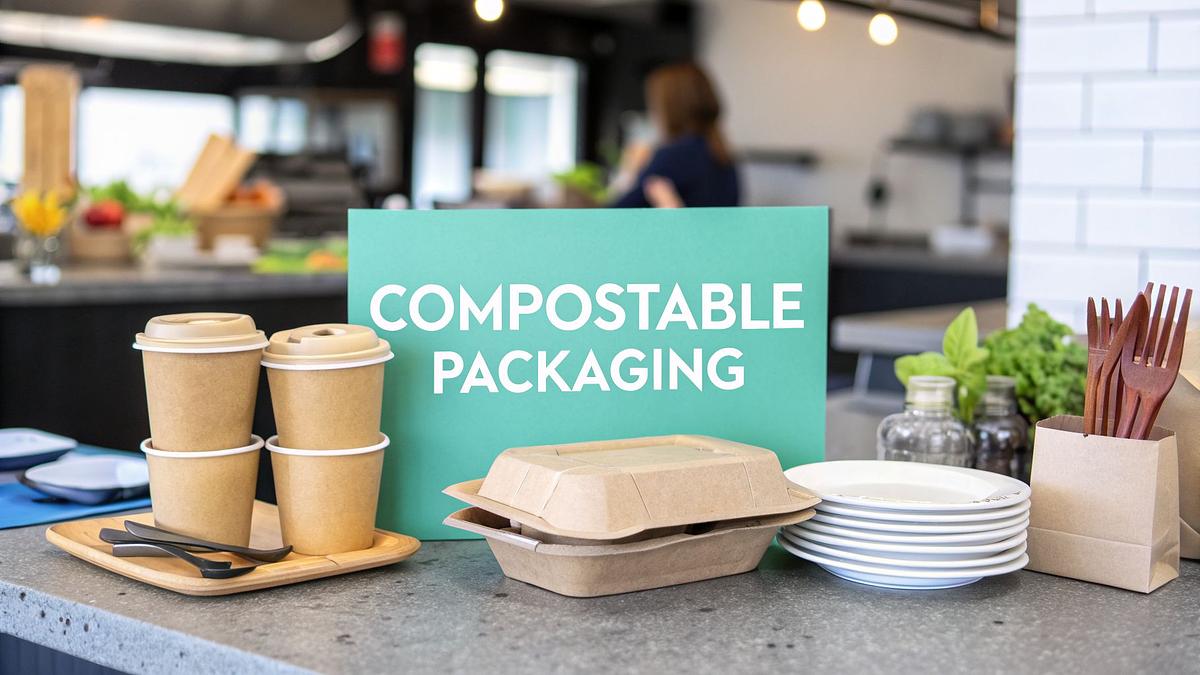
Choosing compostable food packaging isn't just a niche, 'nice-to-have' option for UK hospitality businesses anymore; it's becoming a core part of a modern business strategy. With customer demand for sustainability on the rise and government rules like the Plastic Packaging Tax adding financial pressure, it's no surprise that materials like PLA and bagasse are now a common sight in the UK food service sector.
The Rise of Compostable Packaging in UK Hospitality
For cafés, restaurants, and takeaways across the UK, the switch to compostable packaging presents a real opportunity. It’s a clear and direct response to a much more environmentally aware customer base. In fact, a huge 86.5% of UK adults say they’ve already changed their lifestyles for environmental reasons, making sustainability a massive factor in where they choose to spend their money.
It’s not just about keeping customers happy, either. Government action is pushing businesses in the same direction. Regulations like the Plastic Packaging Tax, which hits any packaging with less than 30% recycled content, provide a strong financial reason to look for better alternatives.
This push from consumers and pull from government is having a big impact. The UK's sustainable packaging market, where compostables are a major player, was valued at USD 9.71 billion in 2024. It’s expected to more than double, reaching a projected USD 18.70 billion by 2033.
Aligning with Modern Business Demands
Embracing compostable solutions helps your business get ahead of these changes. By making the switch, you can:
* Boost your brand image by showing a genuine, practical commitment to the environment.
* Meet customer expectations, building loyalty with patrons who care about sustainability.
* Stay aligned with national environmental targets, showing your business is responsible and forward-thinking.
Of course, embracing sustainable packaging is happening while the UK hospitality sector also faces other major operational pressures, including the ongoing challenges in UK hospitality staffing. Juggling these priorities is simply the reality of running a successful business today.
Ultimately, moving to compostable food packaging is more than just an eco-friendly choice. It’s a smart business decision that gets your operation ready for the future. This guide is here to provide the practical information you need to make the change, from understanding the materials to picking the right supplier.
Compostable vs. Biodegradable vs. Recyclable: What's the Real Difference?
Getting your head around eco-friendly packaging is one of the biggest hurdles for any hospitality business trying to do the right thing. You'll see the words ‘compostable’, ‘biodegradable’, and ‘recyclable’ used, often as if they mean the same thing. They absolutely do not, and confusing them can unfortunately undo all your good intentions, lead to waste contamination, and even open you up to accusations of greenwashing.
Knowing the difference isn't just about buzzwords; it's about making sure the packaging you invest in can actually be processed by your local waste collection services. Let’s cut through the noise and get clear on what each term actually means for your café, restaurant, or takeaway.
This decision tree shows a simplified path for thinking through your packaging choices when sustainability is a key factor for your business.

As you can see, once you commit to a sustainable route, the choice isn't just "not plastic." It branches out into different material types and disposal systems, each with its own requirements.
Defining Compostable Food Packaging
When a product is labelled compostable, it means it’s made from organic materials (like PLA corn-starch or sugarcane bagasse) that can break down completely into nutrient-rich compost under specific, controlled conditions.
Crucially, it must do this within a set timeframe (usually 90-180 days) without leaving any toxic residues behind. Most of the compostable coffee cups and food containers you'll find are certified for industrial composting. These require the high temperatures and specific microbial conditions of a commercial facility to break down properly – they won't just disappear if thrown in a standard recycling bin or a hedge.
A much smaller number of products are certified for home composting, which is a far cooler and slower process. Always look for official UK and EU certification logos to be sure you're getting the real deal.
What Does Biodegradable Mean?
This is where things get tricky. The term biodegradable is incredibly broad and often misleading. All it means is that a material can be broken down by natural microorganisms over some period of time. It says nothing about how long it will take or what it will break down into.
A plastic bottle is technically biodegradable, but it might take 450 years and will just break into smaller microplastics. Without a strict timeframe and a non-toxic outcome, the 'biodegradable' claim is almost meaningless for food packaging.
Because the term is so vague, it's a much safer bet to focus on materials that are certified compostable or widely recyclable. You can find a more in-depth look at this issue in our article comparing compostable vs. biodegradable materials.
Understanding Recyclable Materials
Recyclable packaging is probably the most familiar concept. These are materials like paper, glass, cardboard, and certain plastics (like PET or HDPE) that can be collected, cleaned, and reprocessed to make something new.
The success of recycling hinges on two things: keeping the material clean and having the right local infrastructure to handle it. For a food business, this is a real-world challenge. A pizza box saturated with grease, for example, can't be recycled. You're also relying on your customers to put the item in the right bin, clean and dry.
Packaging End-of-Life Comparison
To make these distinctions even clearer, here's a quick side-by-side comparison of how each packaging type performs at the end of its life.
| Attribute | Compostable | Biodegradable | Recyclable |
|---|---|---|---|
| Definition | Breaks down into natural elements in a specific timeframe under controlled conditions. | Breaks down by microorganisms over an undefined timeframe. | Can be reprocessed into new materials. |
| Materials | Plant-based plastics (PLA), bagasse, CPLA. | Can include almost anything, including conventional plastics. | Paper, cardboard, glass, aluminium, certain plastics (PET, HDPE). |
| Process | Industrial or home composting (heat, microbes, oxygen). | Natural decomposition. | Collection, sorting, cleaning, and remanufacturing. |
| Outcome | Nutrient-rich compost (soil improver). | Can leave behind microplastics or toxic residue. | New products made from recycled content. |
Ultimately, choosing the right path depends entirely on what can be processed in your area. A certified compostable cup is only a sustainable choice if you have a waste partner who will take it to an industrial composting facility. Otherwise, it's just another piece of general waste heading for landfill.
Common Compostable Materials and Their Best Uses
Choosing the right compostable food packaging is all about matching the material to the menu. It’s a common mistake to think all compostable materials are created equal. They’re not. How they handle heat, moisture, and general wear and tear varies wildly. For any UK hospitality business, getting this right is crucial for keeping food looking and tasting great, and making sure your investment in sustainability actually pays off.

So, let's get into the specifics of the most common materials you’ll encounter. We’ll look at where they come from, what they’re good for, and their performance quirks to help you make a smart choice for your operation.
PLA (Polylactic Acid)
You've almost certainly seen PLA in action. It’s one of the most popular bioplastics out there, usually made from fermented plant starch from crops like corn or sugarcane. This makes it a fantastic renewable alternative to old-school, oil-based plastics.
It looks and feels a lot like conventional plastic—it’s clear, lightweight, and perfect for cold applications. But here’s the catch: standard PLA has a very low heat tolerance, starting to warp at around 40°C. So, hot food or drinks are a definite no-go.
- Best for: Cold drink cups, smoothie cups, salad containers, deli pots, and the clear lids for cold food bowls.
- Performance: Its fantastic clarity is great for showing off colourful salads and drinks. On the downside, it can be quite brittle and might crack if dropped.
- Cost: Generally one of the more affordable bioplastics, but still carries a premium compared to standard PET plastic.
CPLA (Crystallised Polylactic Acid)
Think of CPLA as PLA’s tougher older sibling. It’s the same basic material, but it’s been put through a heating and cooling process that crystallises it. This simple change dramatically boosts its heat resistance, making it far more versatile for a busy kitchen.
You’ll spot it by its opaque, milky appearance, usually in white or black. CPLA can handle temperatures right up to 85°C, which makes it an ideal choice for hot food and drinks.
CPLA is the go-to when you need to handle heat. It fills a huge gap in the market, allowing businesses to find compostable solutions for coffee cup lids and cutlery—items that were once a stronghold for conventional plastics.
This material is a real game-changer, enabling a much more comprehensive switch to compostable packaging across your entire menu. To see how these materials work in tandem, you can explore the relationship between cups and lids in our guide to compostable cups.
Bagasse (Sugarcane)
Bagasse is a brilliant example of upcycling. It’s the dry, fibrous pulp that’s left behind after sugarcane stalks have been crushed to extract their juice. Instead of going to waste, this material is pressed into shape to create remarkably sturdy packaging.
Its natural thermal properties make it a true all-rounder, working well for both hot and cold foods. It's also breathable (so food doesn't get soggy), microwave-safe, and freezer-safe.
- Best for: Hot food takeaway boxes, clamshell burger boxes, plates, and bowls.
- Performance: It's strong and grease-resistant, and it won't buckle under the weight of a hot, heavy meal.
- Cost: Because it’s made from an agricultural by-product, it can be a very cost-effective option.
Paperboard with Compostable Linings
A paperboard box on its own won't hold your soup for long. Traditional takeaway cups and pots get around this with a thin polyethylene (PE) plastic lining, but that makes them a recycling nightmare. The compostable alternative pairs the paperboard with a PLA lining instead.
This clever combination gives you the solid structure of paper with the waterproof barrier of a compostable bioplastic. It means the container can hold hot liquids without falling apart, all while remaining fully compostable in an industrial facility. This is now the standard for quality single-use hot drink cups, food pots, and even some compostable straws.
Navigating UK Certifications and Standards
With so many products claiming to be "green," how can you be sure your packaging is genuinely compostable? This is where official certifications come in. They act as independent, third-party proof that a product will break down as advertised, protecting your business from the very real risk of greenwashing.
Think of these standards as your quality assurance. Getting to grips with them means you can confidently choose cups, boxes, and cutlery that work with the UK’s waste collection systems. It’s the only way to ensure your environmental efforts are actually making a difference, not just creating more problems down the line.
The Gold Standard: EN 13432
In the UK and across Europe, the benchmark for compostable packaging is EN 13432. This is the official, legally recognised standard for materials intended for industrial composting. It’s not a vague guideline; it’s a strict set of pass-or-fail tests.
For any product to carry this certification, it must:
* Break down into small fragments (under 2mm) in less than 12 weeks.
* Biodegrade almost completely (at least 90%) into CO2, water, and biomass within 6 months.
* Leave no harmful residues or heavy metals behind in the final compost.
Keep an eye out for the 'Seedling' logo. This symbol is used throughout Europe to show that a product has met the EN 13432 standard, making it easy to spot compliant packaging from a supplier.
Home vs Industrial Composting Certifications
There's a world of difference between a commercial composting facility and the compost heap at the bottom of a garden. Industrial sites reach consistently high temperatures (55-60°C), which are essential for breaking down tough materials like PLA. A home compost bin is much cooler and the conditions far less predictable.
Because of this, you need to look for a different certification for anything you want to advertise as home compostable.
The main one to look for here is the ‘OK compost HOME’ certification, managed by TÜV AUSTRIA. Products with this mark are specifically designed to break down at lower, ambient temperatures.
This distinction is absolutely critical. An item certified only for industrial composting, like a CPLA coffee cup lid, will just sit in a home compost bin for months or years, contaminating the soil. Always check the logo to make sure you're giving your customers the right disposal advice.
As the UK pushes towards its net-zero targets, the hospitality sector is a huge driver of demand for properly certified packaging. In fact, the UK’s biodegradable packaging market is expected to grow at a CAGR of 5.2% through to 2033. By choosing products with verified certifications like EN 13432, you ensure you’re part of a credible, sustainable solution. You can dive deeper into these trends by reading the full report on the UK's biodegradable packaging market.
A Step-by-Step Guide to Making the Switch
Thinking about moving to compostable packaging? It can feel like a huge undertaking, but if you break it down into a few common-sense steps, the whole process becomes much more manageable. For any UK hospitality business, a bit of planning is all it takes to make a successful switch without causing chaos for your team or your budget. Let’s walk through how to get it right.

This isn’t just about keeping customers happy; it’s about making a smart business move. The UK market for compostable packaging is growing fast, expected to jump from a 4.80% share of all sustainable food packaging in 2024 to 6.10% by 2025. As regulations tighten and customer expectations rise, getting ahead of the curve is a real advantage. You can dive deeper into these market trends and see how compliance can become a competitive edge with research from Grand View Research.
Step 1: Audit Your Current Inventory
First things first: before you even think about buying new stock, you need to know exactly what you’re using now. It’s time to do a full audit of every single-use item you have. That means looking at everything from your coffee cups and lids to takeaway containers, sandwich wrap, napkins, straws and cutlery.
Create a simple spreadsheet or list. For each item, note down its material, size, and how many you get through in a typical week. This inventory audit becomes your roadmap. It tells you what you need to replace, how much you’ll need, and stops you from wasting money by over-ordering.
Step 2: Research Your Local Waste Collection
This is the most critical step in the entire process. Compostable packaging is only an eco-friendly choice if it actually gets composted. Otherwise, it’s just expensive landfill waste. You must find out what your local council or commercial waste contractor can accept.
- Get on the phone: Speak directly to your waste provider. Ask them point-blank if their food or garden waste streams can take certified compostable packaging like PLA, bagasse, and CPLA.
- Confirm the facility type: Do they use an industrial composting facility? The vast majority of food service packaging needs this high-heat environment to break down properly.
- Ask about contamination: Find out what can ruin a batch of compost. This is vital information you’ll need to pass on to your staff and customers.
If your current waste service doesn’t offer industrial composting for packaging, you need to find one that does. Without this crucial link in the chain, all your good intentions and investment will, unfortunately, be for nothing.
Step 3: Educate Your Team and Customers
Your staff are your ambassadors for this change. They need to be confident in what the new packaging is and, just as importantly, how to dispose of it and explain it to customers.
A well-informed team is your greatest asset. Hold a brief training session to explain the 'why' behind the switch and the 'how' of correct disposal. Simple, clear instructions prevent contamination and ensure your efforts succeed.
For customers, clarity is everything. Use simple, bold signage on your bins. A sign with a clear graphic that says, "Food Scraps & All Our Packaging Here," is much more effective than a paragraph of text they won’t read. Make it easy for them to do the right thing.
Step 4: Plan a Phased Rollout
There’s no need to change everything at once. In fact, a phased rollout is often the smartest approach, both financially and logistically. Start small by switching just one or two of your most-used items, like takeaway coffee cups or your main meal containers.
This strategy lets you use up old stock gracefully, test how the new products perform with your hot or greasy foods, and get real-world feedback from your team and customers. Once you’re happy with the results, you can then work your way through replacing the rest of your inventory.
Managing Costs and Finding Value
Let’s be honest: for any hospitality business, the bottom line is king. And when you first look at compostable food packaging, the price tag can feel a little steep compared to traditional plastic. It's easy to see it as just another expense, but that’s a short-sighted view. With a smart purchasing strategy, making the switch can be a financially sound decision for the long run.
It's true, the unit cost for a compostable cup or container is often a few pence higher than its polystyrene or plastic counterpart. But that sticker price is only one piece of the puzzle. Businesses across the UK are quickly learning how to make the numbers work, turning an initial cost into a genuine asset.
How to Handle the Upfront Cost
Thinking clever about how you buy can make a huge difference to the immediate financial hit. It’s not about the price per item, but the total cost of getting that packaging into your business and out to your customers.
Here are a few practical tips from the front line:
- Buy in Bulk: It’s the simplest way to cut costs. Suppliers almost always offer significant discounts for larger orders. If you’ve got the storage space, this is your most direct route to a lower unit price.
- Use Your Supplier’s Storage: Don’t have a massive stockroom? No problem. Many suppliers offer free storage. You can place a large bulk order to lock in the low price and then simply ‘call off’ stock as you need it, keeping your own space free.
- Hit the Free Delivery Mark: Those delivery fees can sting. Most suppliers will ship for free once your order hits a certain value, like £100. Always try to plan your orders to get over that threshold and avoid paying extra for shipping.
The Long-Term Financial Wins
The real return from compostable packaging isn’t just about trimming pennies off your order. It's about what you gain—and what you avoid—down the road. This is an investment in your brand’s reputation and its future.
The real value isn't just in the packaging itself; it's in the customers you attract and the penalties you avoid. Moving away from conventional plastics helps you dodge future taxes and win over a growing crowd of customers who care where their money goes.
Think about these major long-term benefits:
- Avoiding Plastic Taxes: The UK's Plastic Packaging Tax already hits materials with less than 30% recycled content. Switching to compostables is a great way to shield your business from this and any other government levies that are sure to come.
- Winning Over Green Customers: People genuinely care about sustainability, and it increasingly drives their purchasing decisions. Showing a clear commitment to better packaging can bring new faces through the door and build serious loyalty with your regulars. That translates directly to revenue.
- Boosting Your Brand Reputation: In a crowded market, having strong environmental principles makes you stand out. It sends a powerful message about quality and responsibility that can support premium pricing and solidify your place as a leader.
When you balance smart buying with these long-term gains, the financial case for compostables becomes incredibly compelling. To dig deeper into building a brand that customers love, check out our guide to eco-friendly packaging strategies.
Choosing the Right Supplier for Your Business
The packaging you choose is only half the battle; finding the right supplier is the other. Your relationship with them is more than just a transaction. It’s a genuine partnership that can make or break your move to compostables, affecting everything from your daily operations and budget to your green credentials.
For any UK hospitality business, getting this choice right from the start is absolutely crucial. A good partner gets the pressures of the food service world. They’ll help you manage stock, keep your branding consistent, and ensure the eco-friendly promises you make to your customers are credible and properly backed up.
Key Supplier Vetting Criteria
It’s tempting to just look at the price per unit, but that can be a false economy. A cheaper product is worthless if it turns up late, is constantly out of stock, or doesn't even meet legal standards. To avoid headaches down the line, you need to dig a little deeper.
Think of it as building a reliable supply chain. Here are the non-negotiables to focus on:
- Proof of Certification: Don't just take their word for it. Ask for documentation proving their products meet the EN 13432 standard for industrial composting. A transparent supplier will have this information ready and waiting for you.
- Comprehensive Product Range: Can one supplier give you everything you need? Sourcing your compostable cups, containers, napkins, and straws from a single place streamlines your ordering and saves you a world of admin.
- Service and Reliability: In this industry, you can't afford to wait. Guaranteed UK delivery times are a must. A promise of a 48-hour turnaround, for instance, isn't just a convenience—it’s a lifeline during a surprisingly busy week.
Value-Added Services to Look For
The best suppliers do more than just shift boxes. They offer practical services that make your life easier and can deliver real financial benefits that easily offset a slightly higher unit cost.
Choosing a partner that offers flexibility can be a game-changer for smaller businesses. Services like low minimum orders for custom branding or free storage options empower you to compete with larger chains without a massive upfront investment.
Before you commit, be sure to ask if they offer these valuable extras:
- Free Samples: You wouldn't put a new dish on the menu without tasting it first, right? Always test the packaging with your own food and drink. A good supplier will be happy to send samples so you can see and feel the quality for yourself.
- Low Minimum Order Quantities (MOQs): If you want to brand your packaging, look for suppliers offering custom printing on small runs. Some will do this for as few as 1,000 units, making bespoke packaging a realistic option even for independent cafés.
- Storage and Call-Off Stock: Short on space? Find a supplier offering free storage. This is a brilliant system where you can buy in bulk to get a better price, and they’ll hold the stock for you to simply ‘call off’ as and when you need it.
Supplier Vetting Checklist
Choosing a partner is a big decision, and it pays to be methodical. Use this checklist to compare potential suppliers and make sure you’re covering all the important bases, from product quality to operational support. It will help you see beyond the sales pitch and identify who can truly meet your needs.
| Evaluation Criteria | What to Look For | Importance |
|---|---|---|
| Certification | Clear, verifiable proof of EN 13432 or Home Compostable certification for all relevant products. | High |
| Product Range | A wide selection of items that fit your menu (e.g., cups, lids, containers, cutlery). | High |
| Delivery & Logistics | Guaranteed UK delivery times, clear shipping costs, and a reliable track record. | High |
| Pricing Structure | Transparent unit costs, volume discounts, and no hidden fees. | Medium |
| Minimum Order Quantity | Low MOQs for standard items and, crucially, for custom-branded products. | Medium |
| Customer Service | A dedicated account manager or a responsive, knowledgeable support team. | High |
| Value-Added Services | Offers like free samples, free storage with call-off, and design support. | Medium |
| Industry Reputation | Positive reviews, case studies, or testimonials from similar businesses. | Medium |
| Waste Collection Support | Do they partner with or recommend waste collectors who handle compostables? | Low |
By systematically working through this list, you can confidently select a supplier who won't just sell you products, but will actively support your business’s growth and sustainability goals. A strong partnership here provides peace of mind and a solid foundation for your operations.
Frequently Asked Questions
Switching to compostable packaging is a big step, and it’s natural to have questions. We work with cafés, restaurants, and takeaways across the UK every day, and a few key queries come up time and time again.
Here, we’ve put together some straight-talking answers to help you get the clarity you need to move forward with confidence.
Can All Compostable Packaging Go in a Home Compost Bin?
This is a huge point of confusion, and the short answer is a firm no. Only packaging that is specifically certified for home composting should ever go into a domestic compost heap. You need to look for a specific logo, like 'OK compost HOME', as proof.
The vast majority of compostable food packaging, particularly items like PLA-lined coffee cups or CPLA cutlery and straws, won't break down in your garden. They require the consistently high temperatures only found in an industrial composting facility. If you put them in a cool, home compost pile, they simply won't decompose and will end up contaminating the final compost.
Is Compostable Packaging Always More Expensive Than Plastic?
Let's talk about cost. It's true that on a per-item basis, a compostable container might have a slightly higher ticket price than its traditional plastic alternative. However, looking only at the unit cost doesn't give you the full financial picture.
To understand the real value, you have to weigh that initial price against the wider business benefits. These include:
* Avoiding Plastic Taxes: Moving away from conventional plastics can help you avoid current and future government levies designed to discourage their use.
* Boosting Customer Loyalty: Making a genuine commitment to sustainability is a powerful way to attract environmentally-conscious customers and strengthen your reputation.
* Savings on Bulk Orders: Your per-unit cost can drop significantly when you buy in larger quantities or use a supplier’s ‘call-off’ stock system, where they hold stock for you.
When you factor all this in, the initial investment often makes perfect business sense.
How Do I Tell Customers About Correct Disposal?
Clear communication is non-negotiable. If your customers don't know what to do, your compostable packaging will end up in the wrong bin, causing contamination and undermining the whole effort.
The most effective strategy is to make it almost impossible to get wrong. Use well-designed, clearly labelled bin stations with simple graphics and minimal text. A sign saying "Food Scraps & All Our Packaging Here" is far more effective than a paragraph of instructions.
Don't forget your team, either. A little bit of staff training goes a long way. When your employees can confidently answer questions about which bin to use, it reinforces your system and shows customers you're serious. A small note on your custom-branded packaging, such as on cups or containers, can also be a great final reminder at the point of disposal.
Ready to make a positive change with packaging that performs? Afida provides UK hospitality businesses with premium, certified compostable food packaging and reliable service. Get free 48-hour delivery on orders over £100 and request free samples to find the perfect fit for your menu.
Explore our eco-friendly packaging products.