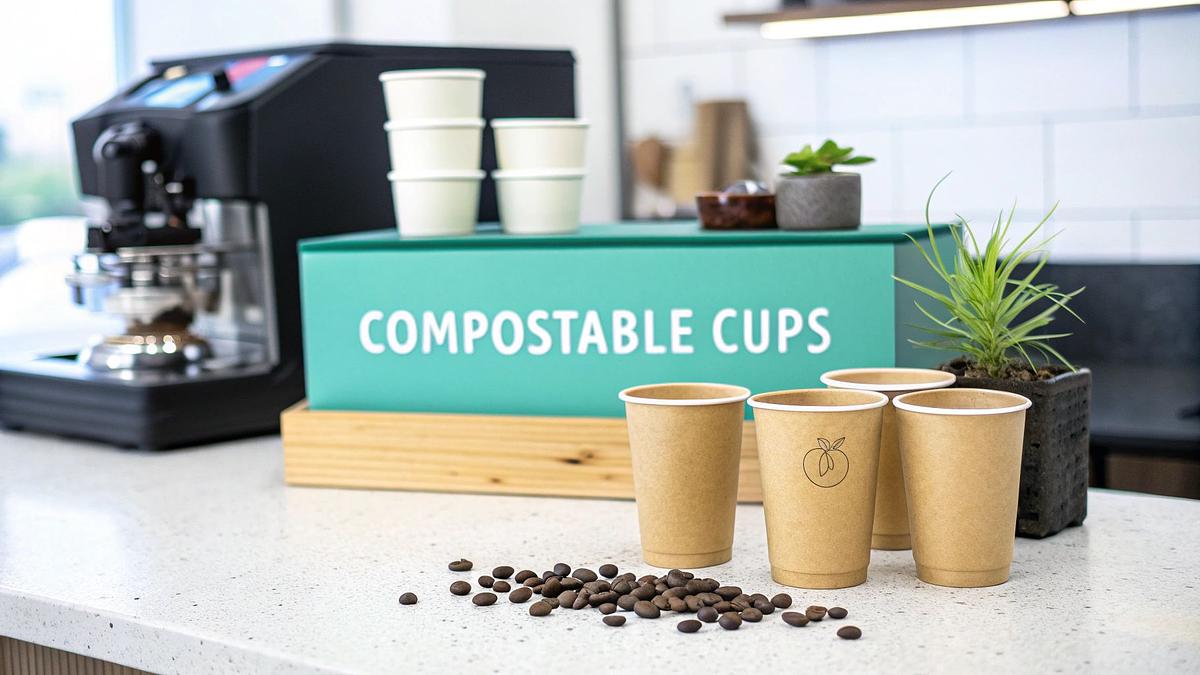
So, you're looking to switch to compostable cups for your hospitality business. It’s a positive step towards sustainability, but it's crucial to understand what you're choosing. A compostable cup isn't just an eco-friendly paper cup; it's a product engineered to break down into natural, non-toxic components, but only under very specific conditions. The goal is for this to happen within a set timeframe, typically around 12 weeks in an industrial facility, which avoids the persistent microplastic problem associated with traditional plastic-lined cups.
Your Practical Guide to Choosing Compostable Cups
Welcome to your no-nonsense guide on compostable cups, created for UK food and hospitality business owners who are serious about making a sustainable difference. We're cutting through the greenwashing to get straight to the practical, honest details. Together, we'll explore what 'compostable' actually means in the UK, break down the different materials from PLA to bagasse, and clarify the vital difference between industrial and home composting.
Our aim is to give you the confidence to select products that genuinely align with your brand's values and, just as importantly, your daily operations. We’ll look at both the benefits and the practical challenges, so you can make an informed investment in packaging that truly performs.
What Makes a Cup Genuinely Compostable?
For a cup to officially earn its "compostable" badge in the UK, it must pass strict scientific tests. The most critical distinction to understand is industrial vs. home compostable. The simple truth is that almost all compostable foodservice packaging—from cups and containers to straws and napkins—is designed for industrial composting. This means it requires the high temperatures and specific microbial conditions found only in a commercial composting facility to break down properly within that 12-week window.
To ensure you’re buying certified products, look for these official logos:
* The Seedling Logo (EN 13432): This is the European standard certifying a product is suitable for industrial composting.
* OK compost INDUSTRIAL & HOME: These are globally recognised certifications from TÜV Austria that clearly state which composting environment is required.
Exploring the Types of Compostable Cups
The good news is the market has expanded, giving you excellent options. Here’s a quick rundown of the most common types you’ll find:
- PLA-Lined Paper Cups: These are the most common choice. They look and feel just like standard coffee cups, but instead of a plastic lining, they use Polylactic Acid (PLA)—a bioplastic made from plant sources like corn starch. They are great for hot and cold drinks but absolutely need industrial composting.
- Bagasse Cups: Made from sugarcane fibre—a by-product of sugar production—these cups are surprisingly sturdy and excellent at handling hot liquids. They also require industrial composting to break down.
- Aqueous-Coated Paper Cups: This is newer technology. These cups use a special water-based coating instead of a bioplastic film, offering a different material profile while still being designed for commercial composting.
The cost of compostable cups is typically 10-20% higher than standard plastic-lined versions. This should be viewed as an investment in your brand's sustainability credentials, meeting the growing consumer demand for eco-conscious choices.
Making the switch is about more than changing suppliers. It means understanding the product's entire life cycle. From choosing the right cup for a flat white versus an iced latte to navigating the UK's disposal infrastructure, we'll cover the essentials you need to make a solid, informed decision.
Ready to explore your options? You can see our full range of compostable cups or check out our complete eco-essentials collection. For a hands-on experience, why not request free samples to test the quality for yourself?
Understanding What ‘Compostable’ Really Means
The word ‘compostable’ is used frequently, but it’s a specific scientific term, not a vague eco-label. For a cup to be officially certified, it must fully break down into natural, non-toxic elements (biomass, water, and CO2) within a defined period.
Think of it as a recipe: a compostable product needs the right ingredients (the material itself) and the right cooking conditions (the heat, moisture, and microbes of a composting facility) to transform correctly. This controlled process is what makes it work.
Industrial vs Home Composting: The Crucial Distinction
If there’s one thing every UK food business owner needs to understand, it’s the difference between industrial composting and home composting. The reality is that the vast majority of compostable food packaging—cups, lids, containers, straws, the lot—is designed only for industrial facilities.
These commercial sites maintain temperatures of 55-60°C, creating an environment that you simply cannot replicate in a garden compost heap. This intense, sustained heat is the key to breaking down materials like PLA within the required 12-week timeframe. A cup designed for an industrial composter will likely sit for years in a home compost pile without breaking down.
To ensure you're not falling for greenwashing, always look for official certifications printed on the product or its packaging.
- The Seedling Logo (EN 13432): This is the European gold standard, confirming a product is suitable for industrial composting.
- TÜV Austria's 'OK compost' Marks: This globally respected certification has two key labels: 'OK compost INDUSTRIAL' and the much rarer 'OK compost HOME', which tells you exactly which environment it’s designed for.
A product is only truly compostable if it breaks down under the correct conditions, leaving nothing harmful behind. Without the correct disposal route, even a certified cup cannot fulfil its environmental promise.
A Look at the Materials Inside Your Compostable Cups
Getting to know the materials helps you pick the perfect product for your menu. Each has its own strengths and, crucially, its own end-of-life requirements.
PLA-Lined Paper Cups
These are what most people picture when they think of a compostable cup. They look and feel just like a standard paper cup, but a bioplastic called Polylactic Acid (PLA), made from plant starches, replaces the fossil-fuel plastic lining. They perform brilliantly but are strictly for industrial composting.
Bagasse Cups
Made from sugarcane fibre—a waste material from the sugar industry—bagasse is a fantastic, renewable resource. It’s a natural insulator for hot drinks and has a unique, slightly fibrous texture that communicates its eco-friendly origins to customers. Like PLA-lined cups, these must be sent to an industrial composting facility.
Aqueous-Coated Paper Cups
This is newer technology where a special water-based coating replaces the PLA liner. It is gaining ground as an alternative to bioplastics, although industrial composting remains the best disposal route to ensure it breaks down effectively.
It’s also vital to remember that not all compostable cups are built for hot drinks; many clear PLA cups, for example, are designed only for cold liquids. Always double-check the product specifications with your supplier. If you want to dig deeper, our guide on the difference between compostable and biodegradable packaging explains it all.
Choosing the right cup means matching the material to your brand, your drinks, and, most importantly, your waste management plan.
Comparing the Different Types of Compostable Cups
So, you're ready to switch to compostable cups. Excellent decision! But it's not as simple as just picking one type. The right choice depends on what you're serving, the image you want for your brand, and how you plan for their disposal.
Let's walk through the main options you'll find in the UK. Understanding these materials is key to selecting a cup that performs perfectly for your customers and genuinely lives up to its green credentials.
PLA-Lined Paper Cups
These are the most common starting point for businesses moving away from traditional cups, because they look and feel almost identical. The innovation is the lining. Instead of petroleum-based plastic, they use PLA (Polylactic Acid), a bioplastic made from plant starches like corn.
- Best For: Almost everything, hot or cold. They offer familiar sturdiness and good insulation, making them a solid all-rounder for coffees, teas, and soft drinks.
- The Catch: They are designed for industrial composting only. That PLA lining needs the consistently high temperatures of a commercial facility to break down properly. It won't decompose in a home compost heap.
Bagasse Cups
If you want a cup that visually communicates "eco-friendly," bagasse is an excellent choice. It's made from sugarcane fibre, the residue left after juice extraction. It’s a brilliant example of turning an agricultural waste product into something valuable.
- Best For: Hot drinks. Bagasse has fantastic natural insulating properties, meaning the coffee stays hot while the cup remains comfortable to hold.
- The Catch: Just like PLA cups, bagasse requires an industrial composting facility to break down as intended. Its unique, slightly fibrous texture is a strong selling point for some brands, but may not suit every aesthetic.
Aqueous-Coated Paper Cups
This is the new kid on the block. Instead of a PLA film, these cups use a special water-based coating to make them waterproof. It's an interesting technology that provides an alternative to bioplastic linings.
- Best For: A wide range of hot and cold drinks, performing much like their PLA-lined counterparts.
- The Catch: While it’s clever technology, the best and most reliable disposal route remains industrial composting. Always check the manufacturer's specific guidance on these products.
To give you a clearer picture, this diagram shows what we mean when we talk about the industrial composting process that most certified packaging is designed for.
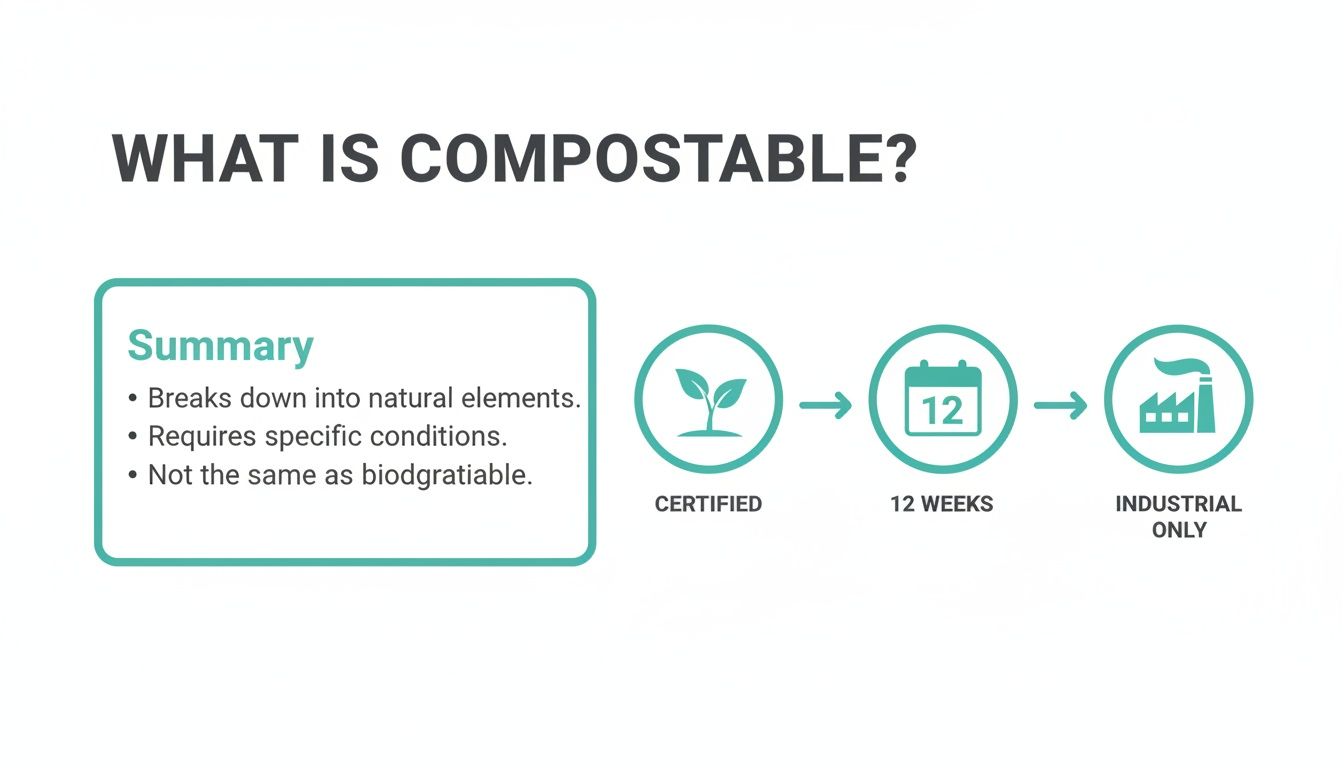
The key takeaway is that certified compostable items are engineered to completely break down into soil within 12 weeks under these very specific, controlled conditions.
Compostable Cup Materials at a Glance
To simplify your decision, here's a quick comparison of the most common compostable cup types available for your business.
| Cup Type | Primary Material | Best For | Composting Requirement | Key Feature |
|---|---|---|---|---|
| PLA-Lined Paper | Paperboard with a corn-starch-based PLA lining | Hot & Cold Drinks | Industrial Composting | Familiar look and feel, excellent all-rounder. |
| Bagasse | Sugarcane Fibre (a waste by-product) | Hot Drinks | Industrial Composting | Excellent natural insulation and a distinct, earthy texture. |
| Aqueous-Coated Paper | Paperboard with a water-based dispersion coating | Hot & Cold Drinks | Industrial Composting | Newer technology, avoids bioplastic film. |
Ultimately, the best choice depends on what you value most—be it the classic feel of a PLA-lined cup or the visual eco-statement of a bagasse one.
Making the Right Choice for Your Business
When choosing your cups, you're balancing performance, cost, and brand perception. A PLA-lined cup offers a seamless transition, whereas a bagasse cup immediately communicates a commitment to natural materials. Whatever you pick, it’s part of a bigger story about being a responsible business. For more on this, check out our complete guide to eco-friendly packaging options.
A Quick Word on Cost: Let’s be realistic—compostable cups do cost more. You can typically expect a price premium of around 10-20% compared to standard plastic-lined versions. Think of it less as an extra cost and more as an investment in your brand’s values and in meeting customer expectations.
At the end of the day, the best compostable cup is one that delights your customers and fits into a proper waste collection system. Testing is always the best way forward to see what works for your menu and your brand's unique style.
The Honest Truth About Composting in the UK
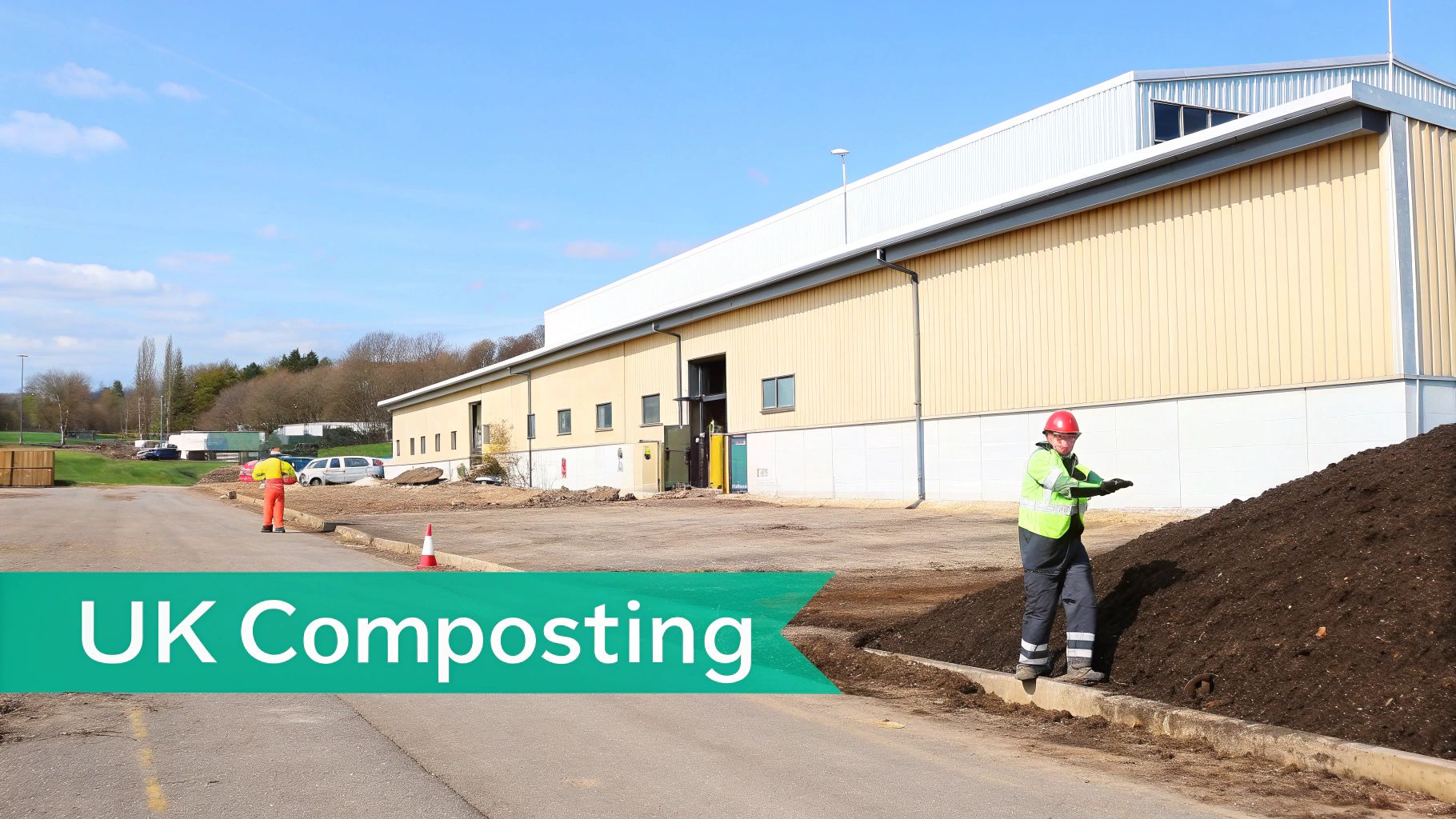
Switching to compostable cups is a fantastic step, but we need to be realistic about the UK’s current composting infrastructure. While the products are designed for a perfect, circular journey, the reality of getting them to the right facility isn't always straightforward.
Being transparent about the challenges is the only way to make genuinely sustainable choices. This will help you understand the landscape and see why compostable packaging is still one of the best investments you can make for your brand's future.
The Council Collection Conundrum
The first major hurdle is disposal. As it stands, the vast majority of UK councils do not accept compostable packaging in their household or commercial food and garden waste collections. This means you can't simply tell customers to toss their used cups into the nearest public food waste bin.
Why the restriction? Many council-contracted facilities are not equipped to process the specific materials and volume of packaging like PLA-lined cups. To avoid contaminating their compost, they often enforce a blanket ban. While the situation is slowly improving, you currently cannot rely on council collections.
The Role of Commercial Composting Facilities
If not the council bin, then where? The answer is specialist commercial composting facilities. These are the sites designed to correctly process certified compostable packaging. They operate at the high, consistent temperatures needed to break everything down into nutrient-rich compost within that crucial 12-week timeframe.
The network of these industrial sites is growing, but access is not yet universal across the UK. This is the crucial part: to close the loop properly, you will almost certainly need to arrange collections with a private waste contractor who services these specialist facilities.
Partnering with the right waste contractor is the single most important step in making your switch to compostable packaging a true environmental success. Without it, your cups cannot fulfil their purpose.
What If a Compostable Cup Ends Up Elsewhere?
Let's be realistic – not every cup will end up in the correct bin. So what happens if one ends up in general waste, or worse, as litter? While not ideal, it is still a far better outcome than the plastic alternative.
Here’s why choosing compostable is still a win:
* It Avoids Microplastics: A compostable cup is designed to biodegrade into natural elements. A conventional plastic-lined cup will persist for centuries, breaking down into harmful microplastics that pollute our environment.
* It's Made from Renewable Resources: The raw materials—like corn starch for PLA or sugarcane for bagasse—are grown, not drilled from finite fossil fuels.
Making the right choice also means weighing up the alternatives. You can dive deeper into this in our detailed comparison of recyclable and compostable coffee cups.
Ultimately, choosing compostable packaging is a forward-thinking decision. It prepares your business for the future of waste management and shows your customers you’re serious about making better choices, even while the national infrastructure plays catch-up.
Calculating the Real Cost of Sustainable Cups
Let's be upfront about the numbers. Switching to sustainable packaging is an investment. Yes, compostable cups typically cost more per unit than their traditional, plastic-lined counterparts. But looking only at the per-item price misses the bigger picture.
Viewing this as just another expense is a mistake. It's a strategic brand decision. Your customers are more aware than ever about environmental impact and actively seek out businesses that share their values. You’re not just buying a cup; you’re investing in a brand identity that people are willing to support.
The Price Premium: A Realistic Look
So, what's the difference? On average, you can expect compostable cups to cost 10-20% more than conventional ones. This "premium" reflects the cost of growing and processing renewable materials like PLA or bagasse, which is a more complex supply chain than that for fossil-fuel plastics.
While that might give you pause, it’s crucial to weigh this against the return on investment. This isn’t just about spending more on disposables; it's about aligning your business with a powerful shift in consumer behaviour.
Meeting a Growing Consumer Demand
The push for sustainable options is not a passing trend. It's a fundamental change in customer priorities, creating a strong commercial incentive for businesses to adapt.
Customer awareness across the UK is fuelling significant demand for compostable products. The European market for biodegradable cups is predicted to grow by 8.3% annually, demonstrating that people are voting with their wallets for greener options. You can find more data on this trend over at cognitivemarketresearch.com.
The data is clear. Customers aren't just ready for this change; they're driving it.
By investing in compostable cups, you're not just following a trend—you're responding directly to what your customers are asking for. It shows you're a business that listens and takes its responsibilities seriously, setting you apart from the competition.
Turning an Expense into a Marketing Asset
That slightly higher unit cost can be transformed into one of your most effective marketing tools. It gives you an authentic story to tell—a story about responsibility, forward-thinking, and a genuine effort to reduce plastic waste. This is invaluable content for your social media, in-store signage, and overall brand image.
Consider the real-world benefits:
- Enhanced Brand Reputation: You become known as the local café or food business that genuinely cares. That positive reputation is worth far more than the few extra pence per cup.
- Increased Customer Loyalty: People who share your values will return again and again. They will actively choose you over a competitor because you are committed to doing the right thing.
- Attracting New Customers: Younger demographics, in particular, often base purchasing decisions on a business's green credentials. Compostable packaging can be the very reason they walk through your door.
When it comes down to it, the decision is about more than the price per cup. It’s about recognising the long-term value of building a strong, sustainable brand that resonates with modern consumers.
Why not start by exploring our full range of compostable cup products or browse our wider eco-essentials collection? The best way to judge the quality is to get your hands on them, so go ahead and order some free samples.
Ready to Make the Switch? Your Next Steps.
You've done the research. You now understand what truly makes a cup compostable, you've compared the different materials, and you have a realistic picture of the UK's waste infrastructure. So, where do you go from here? It’s time to turn that knowledge into confident action for your business.
Choosing a compostable cup is more than another line on a purchase order; it's a visible statement about your brand's commitment to sustainability. By carefully considering materials, checking for certifications, and having a clear disposal plan, you’re making a smart investment in a greener future for your business.
A Simple Plan to Get Started
Ready to take the next step? Making the transition is straightforward when you break it down. Here’s a practical guide to get you started.
See the Big Picture: A compostable cup is a great start, but it’s just one piece of the puzzle. Explore a full range of eco-essentials — think compostable food containers, napkins, and straws — to build a consistent sustainability story across your entire operation.
Zero in on the Cups: Now, let's get specific. Browse a curated selection of compostable cup products to directly compare materials like PLA-lined paper and bagasse. Pay attention to practical details like heat retention and lid compatibility to find the perfect match for your needs.
Get Your Hands on Them: You wouldn't buy new equipment without testing it, and your cups should be no different. The only way to be certain about quality is to hold it yourself. Ordering free samples lets you test how a cup feels, how sturdy it is, and how well it performs before you commit to a full order.
Moving to compostable cups is more than a procurement decision; it’s a commitment to your customers and your principles. Taking the time to test samples ensures that this sustainable choice is also a smart, practical one for your business.
This final step is perhaps the most crucial. It removes all guesswork from the process. When you can feel the quality difference, you can be absolutely sure your new cups will deliver the excellent experience your brand is known for, giving both you and your customers something to feel good about.
Got Questions About Compostable Cups? We've Got Answers
Switching to compostable packaging is a positive move, but it's natural to have questions. To help you make the right choice for your food service business, here are straightforward answers to the questions we hear most often.
Can compostable cups go in my regular recycling bin?
This is a common question, and the answer is a clear no. Compostable cups, particularly those with a PLA lining, are a contaminant in standard paper and card recycling streams.
Think of it this way: paper recycling is designed to process just paper, and plastic recycling is for specific types of plastic. A compostable cup is a composite material, and its bioplastic lining requires the unique conditions of an industrial composting facility to break down. Putting it in the recycling bin can ruin a whole batch of recyclable material.
Do I need a special bin for my customers?
Ideally, yes. Having a dedicated, clearly labelled bin is the most effective way to ensure your cups end up in the right place. Clear signage is your best friend.
A simple sign like ‘Compostable Packaging & Food Waste Only’ helps guide customers and prevents your compostable waste stream from being contaminated with non-compostable items like plastic bottles or crisp packets. This is essential if you have partnered with a commercial waste collector who handles compostables.
It's worth remembering that even if a compostable cup mistakenly ends up in general waste, it's still a better outcome than a conventional plastic-lined cup. It’s made from renewable materials and won’t shed harmful microplastics as it degrades. It is the lesser of two evils, even in a worst-case disposal scenario.
Are all compostable cups good for hot drinks?
Not necessarily, and this is a crucial detail to check before you order. Most PLA-lined paper cups and bagasse cups are specifically designed for hot drinks. They offer excellent insulation and can handle everything from a piping hot coffee to strong tea.
However, be careful with clear PLA cups. Many of them are designed for cold drinks only, as they can warp or lose their shape when filled with hot liquids. The best practice is to always check the product specifications with your supplier. Even better, request samples to test with your own drinks—it’s the only way to be certain they meet your quality standards.
Choosing the right compostable cup is about more than just being green. It's about performance, customer experience, and end-of-life. Get these details right, and you'll know your sustainable choice is also a smart one for your business.
Ready to see the quality for yourself? Afida makes it easy to find the perfect sustainable solution. You can explore our full eco-essentials collection or request free samples of our compostable cups to put them to the test.