The difference between compostable and biodegradable is simple but crucial for any UK food business. Compostable products are certified to break down into nutrient-rich soil within a set timeframe, under specific composting conditions. Biodegradable, on the other hand, just means something will break down eventually—a vague claim with no guarantee on how long it takes or what it leaves behind. For a reliable, sustainable choice, certified compostable is the only answer.
Clearing Up The Confusion: What Compostable vs. Biodegradable Really Means
If you run a café, restaurant, or any food service business in the UK, you’re likely navigating a sea of terms like ‘eco-friendly’, ‘green’, and ‘sustainable’. When it comes to your packaging, however, the two most critical (and confusing) labels are compostable and biodegradable.
Getting this right isn’t just about terminology. It’s about making smart purchasing decisions that reflect your brand’s values, meet customer expectations, and, most importantly, work with UK waste collection services. Let's cut through the noise and get straight to what you need to know.
Defining The Terms: A Regulated Promise vs. A Vague Claim
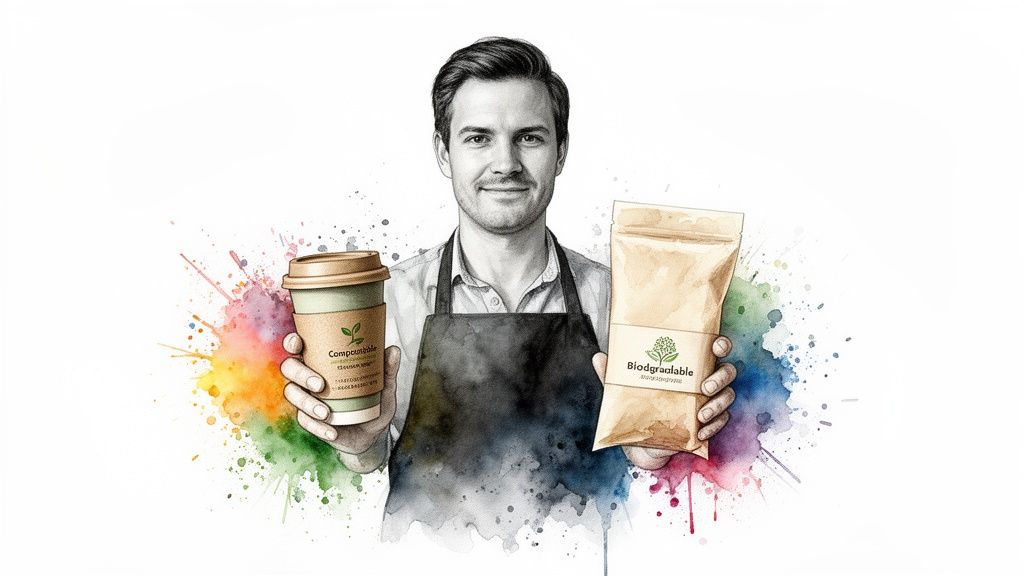
At its heart, the distinction is all about regulation and reliability. One term is a certified promise, the other is often just a marketing tactic.
Compostable: This is a regulated, certified term. For a product like a coffee cup, takeaway container, or napkin to be labelled compostable, it must completely break down into non-toxic components (water, biomass, CO₂) within a specific period. In an industrial composting facility, this is typically 12 weeks. It leaves nothing harmful behind and becomes usable compost, enriching the soil.
Biodegradable: This term is largely unregulated and can be seriously misleading. It simply means an item will eventually break down through natural processes. The catch? The timeframe is completely undefined—it could be a few years or a few hundred years. An oak table is biodegradable, but you wouldn't class it as eco-friendly packaging.
This lack of regulation makes "biodegradable" a favourite for 'greenwashing' – making products sound much better for the planet than they actually are.
Home vs. Industrial Composting: A Crucial UK Distinction
It's also vital to understand that not all composting is equal. The vast majority of food service packaging—from cups to containers and straws—is certified for industrial composting.
These commercial facilities create the perfect high-temperature environment needed to break down bioplastics like PLA. In contrast, home compostable items are designed for the much lower, variable temperatures of a garden compost bin. For your business, this means checking which type of commercial food waste collection is available in your area.
The key takeaway for any food business is that certified compostable products are designed to go straight into the food waste stream along with food scraps. This simplifies disposal for everyone, especially for food-soiled items that can't be recycled.
Compostable vs Biodegradable vs Recyclable: A Quick Comparison
To make smarter choices, it helps to see how these options really stack up.
| Factor | Compostable | Biodegradable | Recyclable |
|---|---|---|---|
| Timeframe | 12 weeks | Undefined | N/A |
| Certification | Regulated | Unregulated | Varies |
| Best for | Food-soiled items | Marketing claims | Clean packaging |
Ultimately, for items like used napkins, greasy takeaway boxes, and coffee cups contaminated with drink residue, certified compostable is the superior and most responsible choice.
You can explore a full range of certified compostable options in our eco-essentials collection. If you want to see the quality for yourself, just ask us for some free samples.
The Critical Difference In How Materials Break Down
To get to the bottom of the compostable vs. biodegradable debate, we need to look past the marketing slogans at how these materials actually behave. The science isn't complicated, but the distinction is absolutely vital for any UK food business wanting to make a genuine eco-friendly choice.
Ultimately, it’s the difference between a certified promise and a hollow claim.
The Marketing Catch Behind "Biodegradable"
Here’s the hard truth: the term biodegradable is so broad that it has become almost meaningless for packaging. It simply means a material can be broken down by microorganisms over time. The problem is, that "time" isn't defined.
Given a few centuries, nearly everything will biodegrade—a plastic bottle, a car tyre, you name it. This lack of a specific timeframe or official standard makes the label dangerously misleading. A "biodegradable" cup could sit in a landfill for 500 years, fragmenting into harmful microplastics as it slowly breaks apart, and still technically fit the definition.
For your business, this lack of regulation means there's no guarantee of any environmental benefit. It's a marketing term, not a scientific standard.
Compostable: A Certified Standard You Can Trust
In stark contrast, compostable is a protected and scientifically verified standard. For any product to be certified as compostable in the UK and Europe, it must meet the strict criteria of the EN 13432 standard.
This certification is your guarantee that the material will:
* Disintegrate into small pieces within 12 weeks under industrial composting conditions.
* Fully biodegrade into carbon dioxide, water, and biomass within 180 days (six months).
* Leave behind no toxic residues, ensuring the final compost is safe for enriching soil.
These precise conditions—involving high temperatures (55-60°C), moisture, and specific microbes—are only found in industrial composting facilities. It’s this controlled process that turns your used takeaway containers, napkins, and coffee cups into a valuable resource, not a long-term waste problem.
Think of it like this: biodegradable materials just disappear from sight over an unknown period, potentially leaving a toxic mess behind. Certified compostable materials are designed to become part of a circular system, returning to the earth as nutrient-rich soil.
Aligning Your Packaging with UK Waste Infrastructure
This is why understanding your local waste infrastructure is so critical. The vast majority of food service packaging requires the heat and scale of an industrial facility to break down properly.
- Industrial Compostable: Items like PLA-lined cups or kraft food containers need sustained high heat to decompose within the certified timeframe. They must go into a commercial food waste collection bin that goes to an industrial facility.
- Home Compostable: These products are made to break down at the lower temperatures of a garden compost heap. While excellent for certain items, they are far less common for robust, commercial food service packaging.
For any food-soiled item that cannot be recycled, certified compostable packaging offers the only reliable and environmentally sound disposal route. It simplifies waste sorting for your staff and customers, ensuring your efforts contribute to a circular economy. To help you navigate these choices, our guide on eco-friendly takeaway containers offers practical advice.
Understanding this fundamental difference empowers you to see past the greenwashing and invest in packaging that truly supports your sustainability goals.
Navigating Composting Infrastructure in the UK
Choosing the right packaging is a massive first step, but its eco-friendly journey doesn't end when it leaves your premises. Even the best compostable packaging is a wasted investment if it ends up in the wrong place. For any café or restaurant in the UK, understanding the realities of local waste collection is non-negotiable.
Frankly, your sustainability strategy can fall at the final hurdle if your packaging is incompatible with local waste services. It all comes down to matching what you buy with the collections available to your business.
Home vs. Industrial Composting: A Critical Distinction
This is where much of the confusion lies. 'Home compostable' and 'industrial compostable' refer to two completely different breakdown processes, and you must know which one applies to your packaging.
Industrial Compostable: The vast majority of packaging used in food service—from PLA-lined coffee cups to sturdy takeaway boxes—falls into this category. It needs the sustained high temperatures (around 55-60°C) and specific microbial environment found only in a large-scale industrial composting facility to break down within the certified 12-week timeframe.
Home Compostable: These products are certified to break down at the much lower, fluctuating temperatures of a typical garden compost heap. While it’s a fantastic standard, it's less common for the durable, grease-resistant packaging needed in a busy food business.
What does this mean for your business? Your packaging will almost certainly need a commercial food waste collection that is routed to an industrial facility.
Checking What Your Local Council Can Handle
Before you place a large order of compostable packaging, your first task is to do some local research. Commercial waste collection in the UK varies wildly from one council to the next.
Contact your local council's commercial waste department or your current waste management provider. Ask one direct question: "Do you accept certified compostable packaging (EN 13432) in your commercial food waste collection?" Their answer dictates everything.
A clear 'yes' is your green light. If they can process these materials, you can confidently integrate compostable packaging into your operations. If the answer is 'no', that packaging will likely end up in landfill or incineration, negating the environmental benefits.
The Public is Ready for Change
The good news is that public demand and industry momentum are pushing to improve the UK's composting infrastructure. People want systems that can properly handle these materials. This is vital because only properly certified compostable items, like our Bio Fibre straws, can go into food waste streams without causing contamination.
The Crucial Role of Avoiding Contamination
Once you've confirmed you have the right collection service, the final piece of the puzzle is keeping it clean. This means ensuring only compostable items and food scraps make it into your designated bin.
Conventional plastics are the number one contaminant. A single plastic lid or fork can ruin an entire batch of compost. This is where clear communication with both your staff and your customers is essential. Use simple, bold signage on your bins and ensure your team is trained to separate waste correctly.
A successful sustainability strategy is a simple formula: Certified Packaging + Correct Local Infrastructure + Clear Communication. Get these three elements right, and your investment will deliver the genuine, positive impact you're aiming for.
How to Read Labels and Identify Trusted Certifications
Walking through the maze of sustainable packaging can be confusing. To avoid being misled by greenwashing, you need to know which labels and certifications actually mean something.
Think of them as a guarantee. Unlike vague terms like ‘eco-friendly’, a certification proves a product has been scientifically tested to meet strict standards. For any UK hospitality business, learning to spot these logos is the key to making genuinely sustainable choices.
Spotting The Official Marks of Approval
When you’re looking at compostable packaging—whether it's cups, containers, or straws—there are a few key logos to look for. These marks separate the real deal from the imitations.
The 'Seedling' Logo (EN 13432): This is the most recognised certification for industrially compostable products across the UK and Europe. If a product carries this logo, it’s guaranteed to meet the EN 13432 standard. That means it will disintegrate within 12 weeks and fully biodegrade within six months in a proper commercial facility.
OK compost INDUSTRIAL: Issued by TÜV Austria, this is another top-tier certification that confirms a product is suitable for industrial composting. It carries the same weight and assurance as the Seedling logo.
OK compost HOME: This certification is for items that can go into a garden compost bin, as it means the product can break down at lower temperatures. You won't see it as often on robust food service packaging, but it's important to recognise.
These logos are your proof of performance. For a deeper dive into the materials themselves, our complete guide to eco-friendly packaging is a great place to start.
Why Vague Terms Mean Nothing
Here’s the hard truth: without one of those official certifications, a claim like "100% biodegradable" is essentially meaningless. It has no legal standing and offers no proof of how the product will perform in the real world. Public frustration with this kind of ambiguity is growing.
The core difference is this: certifications are based on scientific proof, while terms like 'biodegradable' or 'earth-friendly' are based on marketing. Always choose proof over promises to protect your business and your brand's integrity.
Packaging At-a-Glance Comparison
To make things clearer, this table is a quick reference for when you're talking to suppliers or deciding what to stock for your business.
| Factor | Compostable | Biodegradable | Recyclable |
|---|---|---|---|
| Timeframe | 12 weeks in a commercial facility | Undefined, could be centuries | N/A (depends on reprocessing) |
| Certification | Regulated (OK Compost, Seedling logo) | Unregulated | Varies by material and council |
| Best for | Food-soiled items (cups, containers) | Vague marketing claims | Clean packaging (bottles, clean card) |
By focusing on certified compostable products, you align your business with a system that turns waste back into a valuable resource. It’s the most practical and reliable choice for food-soiled items that can't be recycled.
Making The Smartest Choice For Your Food Business
Now that we’ve cut through the jargon, it’s time to apply this knowledge. Choosing the right packaging isn’t just an environmental decision; it’s a strategic move that affects your brand reputation, budget, and operational efficiency. The goal is a packaging strategy that is both responsible and practical for your business.
The principle is simple: match the packaging to its end-of-life destination. For anything contaminated with food, certified compostable is the clear winner. For clean, dry items, recycling remains a great option.
Food-Soiled Items: The Case For Compostable
Picture your takeaway containers, pizza boxes, coffee cups, and napkins during a busy service. They are inevitably going to have food and drink on them. This contamination is the enemy of recycling – even a small amount of grease can ruin an entire batch of paper or card.
This is the exact problem that certified compostable packaging solves. It’s designed to be disposed of along with food waste. This simplifies things for staff and customers, reduces contamination in your recycling bins, and ensures both the packaging and food scraps are turned into valuable compost.
Choosing compostable for food-soiled items is pragmatic. It provides a reliable disposal route for packaging that would otherwise be destined for landfill, turning a waste problem into an agricultural resource.
Clean Packaging: The Role Of Recycling
Recycling absolutely has its place. For items that stay clean and dry, like glass bottles, aluminium cans, or clean plastic containers, recycling is an excellent choice. These materials can be efficiently reprocessed, saving resources and energy.
A sensible approach is to use compostable packaging for your primary food containers (e.g., cups, food boxes) and recyclable materials for items where contamination is less likely. It's worth understanding the finer points here, and you can learn more about the challenges with things like recyclable coffee cups in our detailed guide.
Addressing The Cost Factor
Let’s be direct: certified compostable packaging can sometimes have a higher upfront cost than traditional plastic. However, viewing it purely as an expense misses the bigger picture. In a market where customers actively seek businesses with genuine green credentials, this is an investment in your brand’s reputation.
Offering genuinely sustainable packaging can:
* Attract and retain eco-conscious customers who support businesses that align with their values.
* Strengthen your brand identity as a responsible, forward-thinking operator.
* Future-proof your business against upcoming single-use plastic regulations.
This decision tree shows how to evaluate packaging labels, helping you distinguish between vague marketing buzzwords and trustworthy, official certifications.
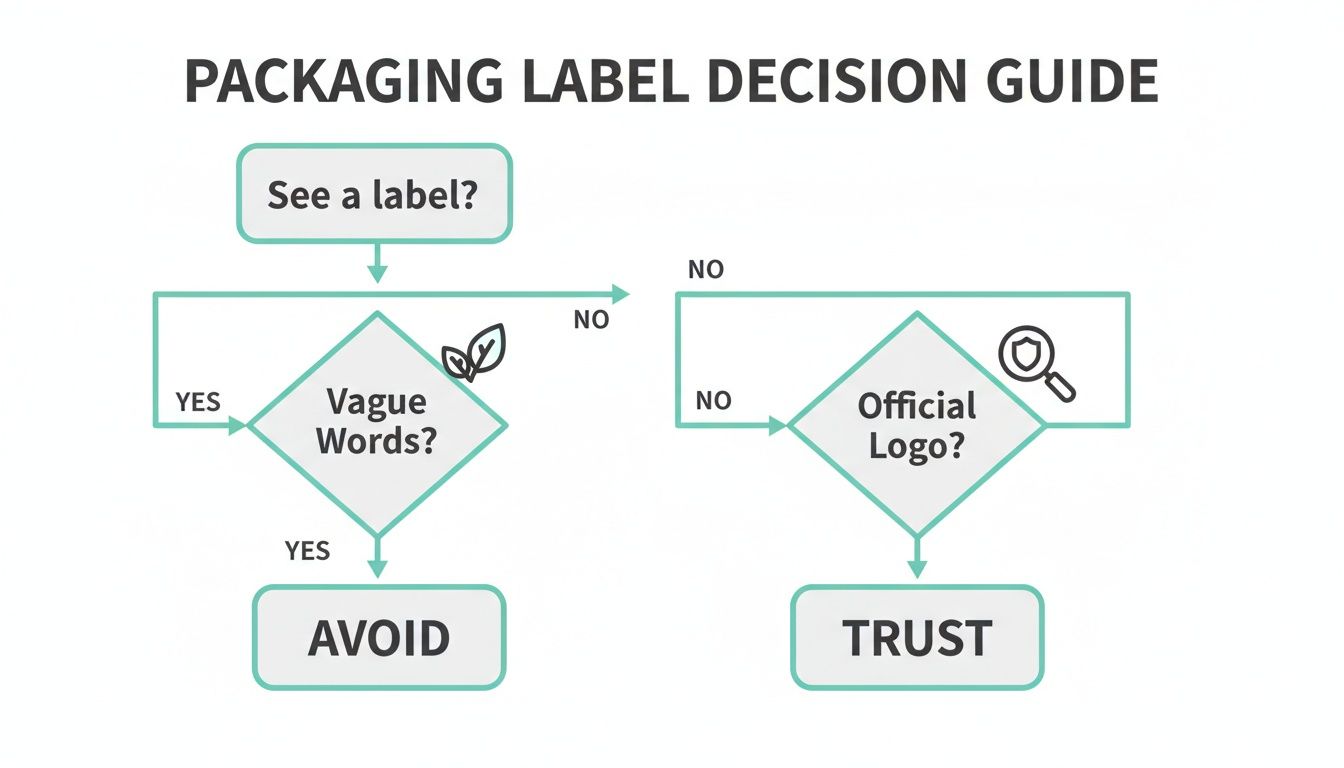
The key takeaway is that verified logos give you a guarantee of performance. Ambiguous words offer no such assurance.
Test The Quality For Yourself
Making a change can feel like a big step, but you don't have to take a leap of faith. The best way to know if a product will work for you is to get your hands on it. We encourage you to request free samples from our eco-essentials collection to test our compostable cups, containers, napkins, and straws in your own setting. It's the perfect way to build a packaging strategy that aligns with your brand, budget, and local waste capabilities.
Frequently Asked Questions About Sustainable Packaging
Even with a good grasp of compostable vs. biodegradable, practical questions always come up. Here are straight-talking answers to the questions we hear most from UK cafés, pubs, and restaurants.
Is Biodegradable or Compostable Better?
For food service packaging, compostable is the better choice every time. Certified compostable products (look for EN 13432, the Seedling logo, or OK compost) are guaranteed to break down into safe, usable compost within 12 weeks at an industrial facility. "Biodegradable" carries no certification, no timeframe, and no guarantee about what is left behind, which is why it is so often used for greenwashing.
Are Compostable Products More Expensive?
It’s true that on a per-unit basis, certified compostable packaging can have a slightly higher price tag. But looking only at the initial cost doesn't tell the whole story. Many businesses find this small premium is easily offset by the value it adds to their brand.
Think of it less as an expense and more as an investment in customer loyalty. People are actively seeking businesses that take sustainability seriously. Using certified packaging sends a clear signal that you share their values, which often translates into repeat business. We always suggest trying free samples first, so you can see and feel the quality before making a decision.
What Happens If Compostable Packaging Ends Up In Landfill?
This is a critical point. If certified compostable packaging goes to landfill, it loses its environmental benefits. Landfills are sealed environments, starved of oxygen. This anaerobic condition stops the composting process in its tracks.
Instead of turning into soil, the packaging will break down very slowly, releasing methane—a greenhouse gas over 25 times more potent than carbon dioxide. This is exactly why it's so vital to match your packaging to your local waste collection services, ensuring it reaches an industrial composting facility.
Can I Put All Compostable Packaging In My Home Compost Bin?
No, and this is a common and damaging misconception. The vast majority of food service packaging is certified for industrial composting only. Materials like PLA (the lining in coffee cups or clear salad boxes) need the sustained high temperatures of 55-60°C to break down correctly.
Your garden compost bin simply doesn't get that hot. Only items carrying a specific ‘Home Compostable’ certification (like the OK compost HOME logo) are designed for a home setup. Always check the label.
Key Takeaway: For a busy café or restaurant, the rule of thumb is simple: unless it is explicitly marked for home composting, all your compostable packaging must go in the commercial food waste bin.
How Do I Explain The Difference To My Customers and Staff?
Simple, clear communication is your best tool. For customers, use straightforward signage on your bins.
A clear message is always best:
* "All Our Packaging & Food Scraps Go Here"
* "Please put our compostable cups, containers, and leftover food in this bin."
For your team, keep training direct. Explain that compostable means it’s designed to become soil, but only if it goes to the right facility. Make it clear that correct sorting is the most critical part of your sustainability efforts. An informed team is your biggest asset in achieving your green goals.
By tackling these practical questions, you can build a packaging strategy that's not just good for the planet, but also works seamlessly for your staff and customers.
Ready to switch to packaging that aligns with your brand and your customers' values? Explore the full range of certified compostable options in the Afida eco-essentials collection or request free samples to test the quality for yourself.