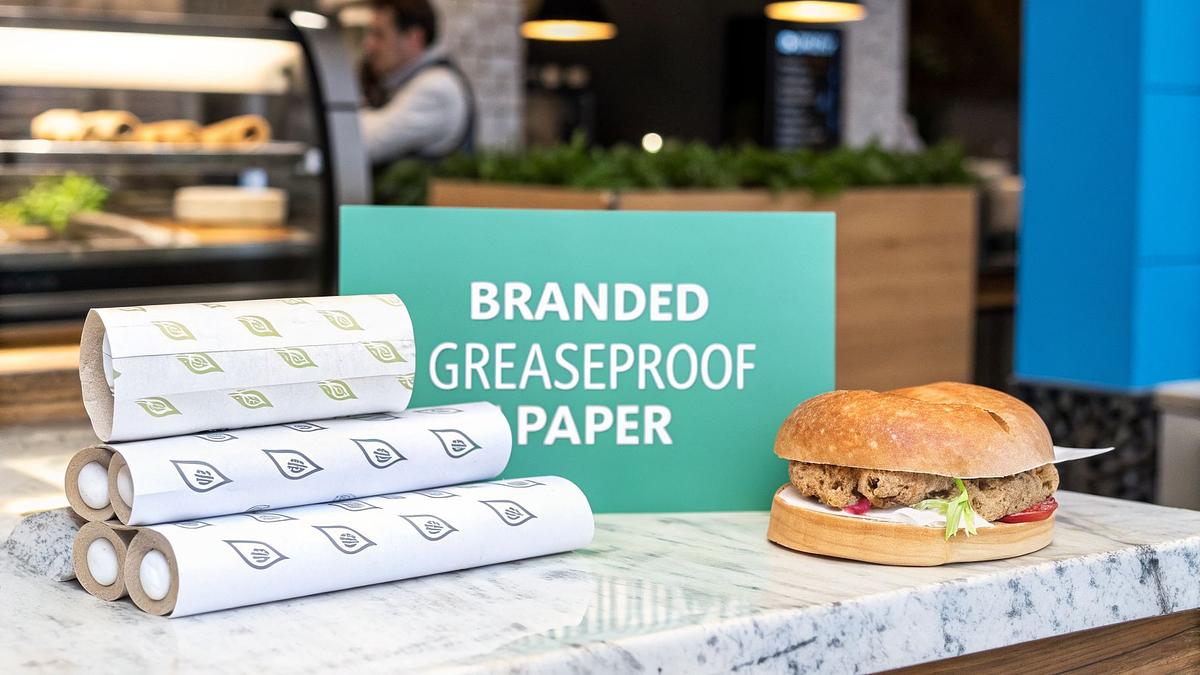
Branded greaseproof paper is one of the smartest, most cost-effective marketing tools for any UK hospitality business. It does more than just keep your food fresh; it transforms a simple necessity into a tangible piece of your brand's story with every sandwich, pastry, or takeaway meal you sell.
The Power of a First Impression
Picture this: a customer in your busy café unwraps a warm sausage roll, or someone at home opens up their takeaway box. That first moment—the distinctive crinkle of the paper, the flash of your logo—is a huge opportunity. It’s their first physical interaction with your food. Custom-printed greaseproof paper turns that functional moment into a memorable brand experience.
It’s about more than just keeping grease at bay. Think of it as the stage for your culinary creations. Whether you're lining a wire basket of chips, wrapping a signature brownie, or keeping a pizza box pristine, that branded paper immediately signals professionalism and a real pride in what you do.
Building Your Brand with Every Bite
In the UK's incredibly competitive food scene, it’s the little details that make a business stand out. A thoughtfully designed wrap can say so much about your brand's personality—are you rustic and wholesome, or modern and slick? This subtle reinforcement forges a stronger connection with your customers, often without them even realising it. A good place to start is by understanding the basics of marketing, like how to create brand awareness.
A customer's experience doesn't start with the first bite. It begins the moment they see and touch your packaging. Custom paper makes that first contact a positive and lasting one.
This level of presentation isn't a luxury anymore; it's a key way to differentiate your business. It makes your products look more appealing, boosts their perceived value, and might just be the thing that encourages a customer to snap a photo for social media—hello, free marketing!
A Smart Investment in Sustainability and Marketing
Today’s UK customers are more eco-conscious than ever. Choosing responsibly sourced, branded paper shows them you’re on the same page. When you pair it with other thoughtful choices like compostable cups, containers or paper straws, you’re telling a powerful story. You’re not just serving great food; you're providing an experience that feels good from start to finish.
The demand for sustainable options is soaring. The global greaseproof paper market was valued at USD 1.78 billion and is expected to hit USD 2.33 billion by 2030, with Europe leading the charge. This isn’t just a trend; it’s a direct response from the food industry to what consumers want. When you combine this eco-friendly appeal with a whole suite of custom branded products, you create a strong, consistent message that builds loyalty long before anyone has even tasted your food.
Choosing Your Perfect Paper Partner
Picking the right branded greaseproof paper is about so much more than just how it looks. It's a practical choice that impacts everything from how your food holds up to your brand's eco-credentials and your bottom line. It can feel a bit technical at first, but once you know what to look for, you can pick a paper that truly works for your business, whether you're wrapping a greasy bacon butty or lining a delicate cake tin.
Think of it like a chef choosing their ingredients. You need to match the paper's properties to your menu to make sure your food always looks its best.
Getting to Grips with the Lingo
When you start looking at options, you'll come across a couple of key terms. The first is GSM, which stands for Grams per Square Metre. This is basically the paper's weight or thickness. A lower GSM, say around 38-40, is thinner and more flexible, which is great for wrapping sandwiches or lining trays. A higher GSM feels more premium and robust, perfect for high-end pastries or giving a quality feel to a takeaway box.
The other big one is the grease resistance rating, often shown as a KIT score. This number (usually from 1 to 12) tells you exactly how well the paper will stop oil and fat from soaking through. A lower rating is absolutely fine for drier items like croissants, but for a fully loaded burger or a generous portion of chips, you’ll want a higher rating to avoid any messy disasters for your customers.
To help you get started, this decision tree can quickly point you in the right direction.

It helps you tackle that first big question: are you looking to elevate your brand with a custom print, or is plain, unprinted paper the right fit for now?
Paper Types to Match Your Brand's Vibe
Beyond the technical side, the paper itself tells a story. Each type has a unique look and feel that can either complement or clash with the atmosphere of your café or takeaway. Your choice here should feel like a natural extension of your brand.
Here’s a look at the most common options and what they say about your business.
Greaseproof Paper Options Compared
| Paper Type | Appearance | Best For | Sustainability Notes |
|---|---|---|---|
| Bleached Paper | Crisp, clean, bright white | Modern delis, bakeries, cafés wanting a clean look or vibrant logo print. | Often PEFC or FSC certified. Chlorine-free bleaching processes are the most eco-friendly. |
| Unbleached Kraft | Natural, earthy, light-brown hue | Artisanal, organic, or rustic brands. Great for a wholesome, crafty feel. | Typically has a lower environmental impact as it skips the bleaching stage. |
| Baking Parchment | Silicone-coated, often slightly translucent | High-heat baking applications, lining tins, and non-stick cooking. | Reusable for some applications, but the silicone coating can complicate recycling. |
| Wax Paper | Wax-coated, semi-translucent | Wrapping cold items like sandwiches or lining sweet boxes (not oven-safe). | Generally not recyclable or compostable due to the wax coating. |
Choosing between a crisp white or an earthy brown paper is about finding the one that feels right for your food and your brand's personality.
Your choice of paper sends a message. A clean white sheet suggests modern efficiency, while a rustic kraft wrap hints at something wholesome and handcrafted. It’s a tiny detail that reinforces your brand identity before your customer even takes their first bite.
The best way forward is to find that sweet spot between performance, branding, and budget. Never hesitate to ask suppliers for samples! Feeling the paper's weight and, more importantly, seeing how it actually performs with your food is the only way to be sure. Test how a 40 GSM kraft sheet handles your signature fried chicken wrap versus how a 50 GSM bleached sheet presents a slice of gooey brownie.
This hands-on approach guarantees your branded paper doesn't just look the part, but also delivers the practical performance your busy kitchen needs. It’s a small investment that makes a massive difference to your operations and your customers' experience.
Bringing Your Brand to Life on Paper
This is where the fun begins. It’s the moment your brand jumps off the screen and becomes something your customers can actually touch and feel. Getting the design right for your greaseproof paper is a blend of creative flair and a few practical, technical details. Nail it, and your paper becomes a massive part of your customer experience.

First things first, what do you want your paper to do? Are you going for a bold, in-your-face logo that everyone will remember, or something a bit more subtle and upmarket? The answer will guide your entire design.
From Simple Logos to Intricate Patterns
You can go as simple or as complex as you like with your design. For a bustling UK food business, both approaches have their own distinct advantages.
A straightforward, repeating logo is often the hardest-working option for cafés and takeaways. It’s all about building that brand recall. Think of it as a constant, gentle nudge. Every time a customer unwraps their sandwich or uses the paper as a tray liner, your logo is right there, reinforcing who you are.
On the other hand, a beautifully intricate pattern can create a really special, memorable unboxing moment. This is a brilliant move for artisan bakeries, high-end delis, or caterers who want to communicate a sense of craftsmanship and real attention to detail. It elevates the packaging from a simple wrapper to something that feels more like a custom gift wrap for your delicious food.
One-Colour vs Full-Colour Printing
Next up is the big decision: colour. This choice will directly affect both the look of your paper and your budget, so it’s worth weighing up the options.
One-Colour Printing: This is your most budget-friendly route and is fantastic for creating a clean, minimalist aesthetic. A single, sharp colour—like a bold black print on natural kraft paper—can look incredibly chic and make a real statement. It’s a great way to get a professional finish without a huge upfront cost.
Full-Colour Printing: If your brand identity is built around a specific colour palette or a vibrant, multi-coloured logo, then this is the only way to go. It gives you total creative freedom to make sure your packaging is a perfect match for everything else, from your shop sign to your menus. The set-up costs are higher, but the visual impact can be phenomenal.
Whichever path you take, having a solid grasp of your visual identity is key. If you're looking to explore this further, our guide on the essentials of building a strong brand is packed with useful advice.
The Technical Details Your Supplier Needs
Right, you’ve got your design sorted. Now, you just need to get it to your supplier in a format they can actually use to create a crisp, professional print. This sounds more complicated than it is.
The single most important thing for any custom print job is providing "print-ready" artwork. This almost always means supplying a vector file, which allows your design to be scaled up or down without losing any quality whatsoever.
Your printer will ask for your artwork in one of the following formats:
Vector Files: These are the gold standard. You'll be looking for files ending in .AI (from Adobe Illustrator), .EPS, or sometimes .SVG. Unlike a standard image file like a JPEG, which is made of pixels, vectors are built from mathematical paths. That means they can be resized infinitely without ever going blurry or jagged, guaranteeing a sharp finish on your paper.
High-Resolution PDFs: Some printers might accept a high-resolution PDF with the artwork embedded, but honestly, a proper vector file is always what you should aim for.
Finally, there’s one last detail that really matters to today’s customers: the ink. Always insist on using food-safe, vegetable-based inks. Not only are they completely safe for direct contact with your food, but they’re also the more sustainable choice, aligning your packaging with an eco-conscious ethos. It's a small detail that says a lot about your commitment to quality and care—a message that really hits home with UK shoppers.
Making a Sustainable Statement
Let's be honest, today's customers in the UK care about more than just what's in their food; they care about what it comes in. Your packaging choice is a huge, visible part of your brand story. Choosing sustainable branded greaseproof paper is a brilliant way to show you’re serious about quality and the environment, all without having to say a word.
This isn't about making grand, sweeping gestures. It's about the small, thoughtful choices that add up and really connect with an increasingly eco-aware audience. When a customer sees you've put thought into the lifecycle of your packaging, it builds an instant layer of trust and shows you share their values.

Navigating the Eco-Friendly Terminology
The world of sustainability has its own language, and it can feel a bit confusing at first. But getting to grips with a few key terms will help you make smarter choices and explain them clearly to your customers.
Let's break down the two main terms you'll see when looking at greaseproof paper:
- Biodegradable: This is a very broad term. It simply means the material will eventually break down into natural elements with a little help from microorganisms. The catch? It doesn't give a timeframe. It could take years.
- Compostable: This is a much higher and more meaningful standard. For a product to be certified compostable, it must break down into non-toxic components within a set period (usually 90-180 days) in a proper commercial composting facility.
For any food business, compostable is the gold standard. It provides a clear, responsible end-of-life plan for your packaging.
Another vital certification to keep an eye out for is the FSC (Forest Stewardship Council) logo.
Spotting the FSC logo on your branded greaseproof paper is your guarantee that the paper comes from responsibly managed forests. It's a simple way to know the timber was harvested in a way that protects biodiversity and supports local communities.
This small symbol gives your business a credible, third-party stamp of approval on its sourcing ethics. For businesses wanting to go a step further in reducing their environmental footprint, exploring options like sustainable newspaper wrapping paper can also be a great move.
Creating a Cohesive Sustainable Story
Your branded paper is a key player, but its impact is even greater when it's part of a full eco-conscious packaging team. Think about the entire customer experience and how every single piece works together to tell the same green story.
Consider how your greaseproof paper fits with everything else:
* Compostable Cups & Containers: Does the paper wrapping a brownie match the branded, compostable cup holding their flat white or the container for their salad?
* Recycled Napkins: Are you handing out napkins made from recycled materials alongside their sandwich?
* Paper or Bio-Fibre Straws: Have you swapped out plastic straws for alternatives that match your takeaway drinks?
When every piece of your packaging, from the wrap to the cup to the bag it goes in, screams sustainability, you're sending a powerful, cohesive message. This consistent approach proves your commitment is genuine, not just a marketing gimmick. If you want to dive deeper into building a complete strategy, check out our guide to the world of eco-friendly packaging. This sort of attention to detail doesn’t go unnoticed and can genuinely be the reason a customer chooses you over the competition.
Smart Applications Across UK Hospitality
It’s one thing to talk about technical specs, but where branded greaseproof paper really comes alive is out in the wild. Across the UK’s incredible hospitality scene, this simple product is a quiet powerhouse, boosting brand image and making the customer experience that much better. It’s all about turning every single order into a memorable moment.

From the local high-street café to a packed city-centre takeaway, branded paper is a practical solution that just looks fantastic. Think of it as an investment that does three jobs at once: it's a hygienic barrier, a presentation upgrade, and a mini-billboard for your business.
For Independent Cafés and Bakeries
For a local café or bakery, the charm is in the details. That unique, artisanal vibe is what keeps people coming back, and branded greaseproof paper is a simple way to wrap up that feeling and send it home with your customers.
- Wrapping Sandwiches and Bakes: A custom sheet wrapped around a sourdough toastie or a fresh croissant instantly makes a simple grab-and-go item feel like a proper treat.
- Lining Cake Trays and Displays: Using branded sheets to line your counter display not only looks sharp but also makes clean-up a doddle, all while keeping your logo front and centre.
- Serving Pastries: A small branded sheet placed under a pastry on a plate adds a lovely touch of class and helps keep the plate clean. It’s a tiny detail, but it’s one that customers absolutely notice.
For Busy Takeaways and Quick-Service Restaurants
In the fast-moving world of takeaways, your packaging is your final handshake with the customer. It needs to work well, look great, and leave a real impression. Branded greaseproof paper is made for this high-energy environment.
The takeaway sector is booming, and the demand for branded paper is growing right along with it at a 10.80% compound annual growth rate. While classic bleached paper still has its place for crisp printing, natural, unbleached options are catching up fast as more people look for products with minimal processing. You can dive deeper into this growing market at Mordor Intelligence.
In a takeaway setting, your branded paper is more than just a liner. It’s the first thing a customer sees when they open their meal—a key part of that ‘unboxing’ experience that makes your food instantly recognisable.
Here’s how it’s commonly used:
* Lining Burger and Chip Boxes: A branded liner stops grease from seeping into the cardboard, keeping the box sturdy and your brand visible until the very last bite.
* Wrapping Burgers and Kebabs: A proper wrap holds everything together, keeps the fillings secure, and gives customers a clean way to eat on the move.
* Serving Street Food: Using branded sheets in chip cones or to serve loaded fries just adds a professional flair that helps justify a premium price.
For Mobile Food Trucks and Event Caterers
When your business is on the move, consistent branding is everything. It's how people spot you in a crowd at markets, festivals, or private events. Branded greaseproof paper is a lightweight, affordable way to create a professional, cohesive look wherever you set up shop.
Food trucks can use it to line serving trays or baskets, instantly connecting the food to the branding on the side of the vehicle. In one simple step, a generic tray becomes part of your brand experience.
For event caterers, hygiene and presentation are non-negotiable. Using branded sheets to line platters of canapés or charcuterie boards doesn’t just look elegant; it also provides a clean, food-safe surface. It's a brilliantly simple way to get your brand noticed on every table at a wedding or corporate do, marketing your services to every guest in the room.
Making Your Order Simple and Straightforward
Let's face it, ordering custom packaging can feel like a chore when you’re already juggling a million things in a busy café or kitchen. But getting your hands on beautifully branded greaseproof paper doesn't have to be a headache. It's actually quite simple once you know what to look for.
The first term you'll bump into is MOQ, which is just industry-speak for Minimum Order Quantity. This is the smallest order a supplier will produce for a custom print run. While a larger MOQ means a bigger upfront investment, the price per sheet plummets, making it a much savvier choice in the long run if you have the storage space.
Timing is Everything: Planning Your Order
Custom printing isn't an overnight job, so a little forward-thinking goes a long way. Unlike grabbing plain supplies off the shelf, your unique paper needs to be designed, have printing plates made just for you, and then go through the actual printing process.
From the moment you give your artwork the final thumbs-up, you should realistically expect a lead time of several weeks for that first delivery. Building this into your schedule is key—it means you’ll never get caught short during a busy service. A bit of planning keeps your branding consistent and saves you from any last-minute stress.
The greaseproof paper market has a few big names, but it’s the specialised regional suppliers who are often the real gems for independent businesses. They tend to offer more personal service, lower MOQs, and quicker turnarounds that fit perfectly with the fast-paced nature of hospitality. You can find more detailed market analysis in this greaseproof paper market report from Valuates Reports.
Smart Services That Save You Space and Money
Worried about finding a home for thousands of sheets of paper? This is a common problem, and the best suppliers have a brilliant solution: free storage and a 'call-off' service.
A 'call-off' system is a game-changer. You commit to a large, cost-effective order to get the best possible price, but the supplier stores it all for you in their warehouse. Then, you just 'call off' smaller batches for next-day delivery whenever you're running low.
This gives you the perfect balance:
* Big Savings: You lock in the fantastic low unit price of a bulk purchase.
* No Storage Headaches: Your precious stockroom space isn't clogged up with mountains of paper.
* Total Convenience: You get quick, reliable deliveries on your terms, without having to manage a huge inventory yourself.
This kind of service turns ordering from a logistical puzzle into a smooth, simple part of your routine. It frees you up to concentrate on what really matters: creating amazing food for your customers.
Frequently Asked Questions
When you're looking into custom packaging for the first time, a few questions are bound to pop up. To help you out, we’ve put together answers to the queries we hear most often from café, deli, and restaurant owners across the UK. Think of this as your cheat sheet for getting started with branded greaseproof paper.
What Is the Typical Cost in the UK?
The final price tag for your branded greaseproof paper really comes down to three things: the paper's weight (GSM), the size of your order, and the complexity of your design. As you might expect, a simple, one-colour print on a standard-weight paper is your most wallet-friendly option.
Of course, a custom print run has a higher upfront cost than grabbing a plain, off-the-shelf pack. The real win, though, is that the price per sheet plummets on larger orders. Many UK suppliers are also offering lower minimum order quantities (MOQs) these days, which is great news for smaller independent businesses. The best first step? Always ask for a custom quote based on exactly what you need.
Is Branded Greaseproof Paper Fully Recyclable?
This is a fantastic question, and the honest answer is: it depends on what's left on it. The paper itself is almost always recyclable. The problem is that once it’s soaked in grease, oils, or covered in food scraps, it can't go in the paper recycling bin because those leftovers can contaminate the entire batch.
Because of this, it’s always best to tell customers to check the specific rules from their local council. The good news is that many modern greaseproof papers are also certified as commercially compostable. This gives you a brilliant, eco-friendly disposal route, especially if you're already using other compostable packaging like takeaway cups or food containers.
How Long Does a Custom Order Take?
A little forward planning is key here. Unlike grabbing standard stock, your custom paper needs to go through the full production journey—from finalising your artwork and making the printing plates to the print run itself.
On average, you should probably bank on a lead time of several weeks from the moment you sign off on the final design to the paper landing on your doorstep. For your first big order, anyway. After that, some suppliers offer a handy ‘call-off’ service. This means they’ll store your bulk order for you, letting you call for smaller batches with quick, often next-day, delivery as and when you need them.
Ready to turn your packaging into a powerful branding tool? At Afida, we make it simple with low minimum orders, high-quality printing, and free storage to save you space and money. Explore our custom branding options today.