Eco-friendly takeaway containers are food packaging solutions designed to have a much smaller environmental footprint. They’re typically made from recycled, renewable, or biodegradable materials, giving UK food businesses a genuinely sustainable alternative to traditional single-use plastics.
The Essential Shift To Sustainable Takeaway Packaging
For anyone running a UK hospitality or food service business, the conversation around sustainability is no longer a "nice-to-have." It’s become a core part of how we operate. Choosing the right eco-friendly takeaway containers isn't just an environmental decision anymore; it’s a smart business move that directly impacts your brand's reputation, customer loyalty, and ultimately, your bottom line.
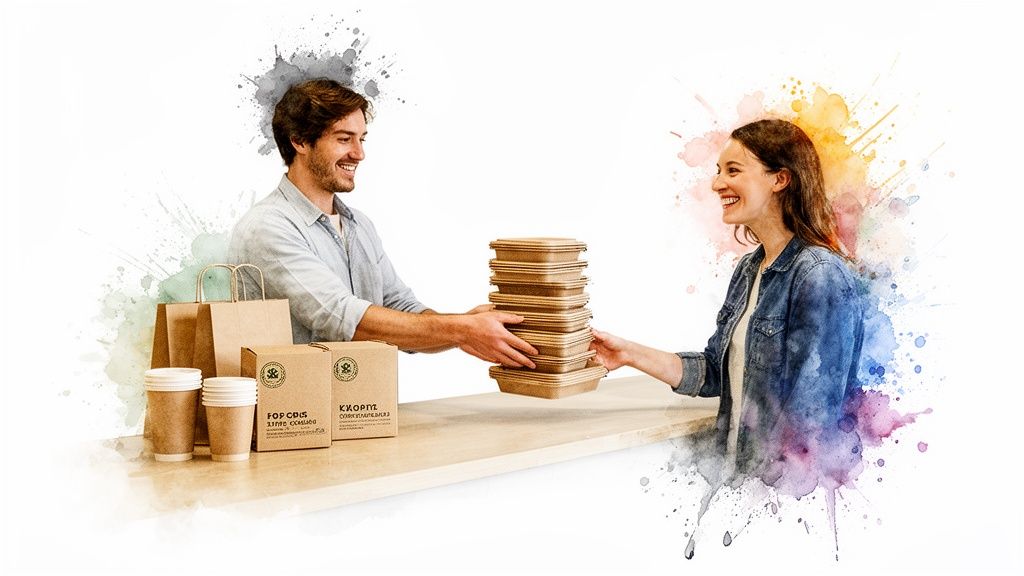
The push to adapt is coming from two places you can't ignore: your customers and the government. Today’s diners are savvy and more environmentally aware than ever before. They actively look for businesses that share their values, and a visible commitment—like serving their food in sustainable packaging—can be the very thing that makes them choose you over a competitor.
Responding to Market Demands
This isn't just a feeling; the numbers back it up. The UK's sustainable packaging market hit a staggering USD 9.71 billion in 2024 and is on track to more than double to USD 18.70 billion by 2033. This boom is being pushed along by decisive government action, like the Plastic Packaging Tax introduced in April 2022. This tax imposes a £200 per tonne charge on plastic packaging that contains less than 30% recycled content. You can dive deeper into the trends with this UK sustainable packaging market report.
This new reality presents a clear choice for cafés, takeaways, and restaurants. If you stick with old-school packaging, you risk losing customers and facing higher operating costs. On the other hand, switching to sustainable alternatives opens up some serious advantages:
Boost Your Brand Image: It sends a clear signal that you care about quality and your environmental responsibility.
Build Customer Loyalty: You’ll attract and keep eco-conscious diners who notice and appreciate the effort.
Future-Proof Your Operations: It helps you stay ahead of ever-tightening regulations and avoid future penalties.
Manage Your Costs: Making smart packaging choices can help you navigate new taxes and cut down on waste expenses.
Think of this guide as your practical playbook for making the switch. We're here to cut through the jargon and give you straightforward advice on materials, performance, costs, and branding for everything from coffee cups and food boxes to napkins and straws. Our goal is to help you make informed, sustainable choices that are good for your business, your customers, and the planet.
What Are Eco-Friendly Containers Actually Made Of?
Choosing the right takeaway container is a lot like picking the right pan for a specific dish. You wouldn't use a crêpe pan to cook a stew, right? The same logic applies here. Getting to grips with the actual materials is the first step, and it’s simpler than it sounds. Once you cut through the jargon, you can find packaging that truly works for your food, your customers, and your brand's values.
Since the UK’s ban on single-use plastics came into force, the demand for smarter, greener options like paper, bamboo, and compostables has skyrocketed. This isn't just a trend; it's a fundamental shift in how the hospitality industry operates.
Let's break down the main players you’ll come across.
Paper and Kraft: The Dependable Classics
Think of Kraft paper as the trusty cast-iron skillet of the packaging world. It’s a real workhorse. Made from wood pulp, its long, strong fibres give it a natural durability that’s hard to beat. This makes it ideal for things that need a bit of strength, like sturdy takeaway bags, classic pizza boxes, or food trays that won't buckle under pressure.
Keep an eye out for the Forest Stewardship Council (FSC) logo. When you see that stamp on a paper or Kraft product, it’s not just marketing fluff. It’s your guarantee that the material comes from forests that are managed responsibly. This is a simple way to sidestep greenwashing and know you’re making a genuinely good choice.
Best for: Great for hot and dry foods – think burgers, loaded chips, sandwiches, and pastries.
Key Benefit: It's a winner for customers because it can go straight into their home recycling bin. Easy.
Heads-up: Basic Kraft paper isn’t built to handle grease or sauces. If you're serving anything saucy, make sure you choose an option with a plant-based lining to prevent leaks.
To help you get a quick overview, here's a simple cheat sheet comparing the most common materials you'll encounter.
Eco-Friendly Material Cheat Sheet
| Material | Made From | Best For | End-of-Life (UK) |
|---|---|---|---|
| Kraft Paper | Wood pulp from responsibly managed forests | Takeaway bags, pizza boxes, dry food trays | Widely recycled in kerbside collections |
| rPET | Recycled plastic bottles (post-consumer) | Cold drinks, salads, deli pots, smoothies | Recyclable in most UK kerbside collections |
| PLA Bioplastic | Plant starches (like corn or sugarcane) | Cold food containers, clear windows, cup lids | Industrial composting only; not for home bins |
| Bagasse | Sugarcane pulp (a farming by-product) | Hot food boxes, bowls, clamshells | Industrial composting; also home compostable |
| Bamboo | Fast-growing, renewable bamboo grass | Plates, cutlery, stirrers, some containers | Commercially compostable; some are home compostable |
This table is just a starting point, of course. The best choice always comes down to matching the material's performance with the specific needs of your menu.
Smarter Plastics: Recycled and Plant-Based Options
Let's be clear: not all plastic is the villain. Recycled PET (rPET) is a brilliant example of the circular economy working as it should. It’s made from old plastic bottles that people have thrown into their recycling bins. These are collected, cleaned, and remanufactured into brand new, food-safe containers. This simple process massively cuts down on the need to create new plastic from scratch.
Using rPET gives a second life to existing plastic, diverting it from landfill and reducing the overall carbon footprint of your packaging. It’s an ideal choice for showcasing vibrant, cold items.
On the other hand, you have Polylactic Acid (PLA). This is a bioplastic made from renewable plant sources like corn starch. It looks and feels just like the clear plastic we're all used to, but its big secret is that it's designed to be commercially composted. Just remember, it’s strictly for cold use – hot food or drinks will cause it to lose its shape.
rPET: Perfect for cold drinks, smoothie cups, colourful salad bowls, and deli pots where you want the food to shine through.
PLA: A solid choice for cold food containers, lids for cold cups, and those little clear windows on sandwich boxes.
New-Wave Materials: Bio-Fibres
This is where things get really interesting. Bio-fibres, often made from agricultural leftovers like sugarcane pulp (known as bagasse) or fast-growing bamboo, are all about turning 'waste' into something genuinely useful. These materials are impressively strong, can be moulded into all sorts of shapes like clamshell boxes or bowls, and have a great, sturdy feel.
A fantastic example is Bio-Fibre straws. They have the durability and feel of a traditional plastic straw but are 100% biodegradable. Crucially, they don't turn to mush in your drink like some of the early paper alternatives did, which means a far better experience for your customers. Many of these modern materials, especially those for hot drinks, are covered in our complete guide to recyclable coffee cups. They represent a premium option for any business that refuses to compromise on performance or sustainability.
Matching Containers To Your Menu: Performance Matters
Choosing eco-friendly takeaway containers isn't just about ticking a sustainability box; it's about performance. Your packaging is the final handshake you have with your customer. It’s the vessel protecting the meal you’ve poured your heart and soul into. If it fails, the entire experience falls flat, no matter how incredible the food was when it left your kitchen.
Picture the classic Friday night curry. A customer orders a creamy chicken korma, a rich lamb rogan josh, and a side of naan. The packaging needs to be robust enough to handle all that delicious sauce and oil without leaking, sturdy enough to be stacked in a delivery bag, and insulated enough to keep everything piping hot. This is where performance is non-negotiable. A flimsy container that sags or leaks doesn’t just make a mess; it damages your reputation.
The right container preserves the texture, temperature, and presentation of your food. It’s the difference between a customer receiving the hot, delicious meal you intended, and them opening a lukewarm, soggy disappointment.
From Soups To Smoothies, Every Dish Has A Need
Different foods place very different demands on their packaging. A one-size-fits-all approach just doesn't cut it, because the needs of a hot soup are a world away from those of a chilled salad or a greasy burger. Getting your head around these specific requirements is the key to making the right choice.
For example, hot liquids like soups, broths, and curries demand containers with excellent heat retention and, most importantly, secure, leak-proof lids. Let's be honest, there's nothing worse for a customer than a bag soaked in their dinner. On the flip side, fried foods like fish and chips or loaded chips need packaging with good ventilation to stop steam turning them soggy. A container with a few small vents lets moisture escape, keeping everything perfectly crisp.
Here are a few common menu items and what they need to thrive:
Hot Soups & Curries: Insulated, leak-proof Kraft or bagasse bowls with tightly fitting lids.
Burgers & Wraps: Grease-resistant Kraft paper or clamshell boxes that can handle oils without falling apart.
Salads & Cold Dishes: Clear rPET containers are brilliant for showing off freshness and vibrant colours, with secure lids to keep dressings contained.
Coffee & Hot Drinks: Double-wall insulated paper cups are essential to protect hands and maintain that perfect temperature.
Smoothies & Iced Coffees: You'll need sturdy rPET or PLA cups with domed or flat lids that have a secure straw slot.
This quick concept map shows some of the core material families and where they come from.
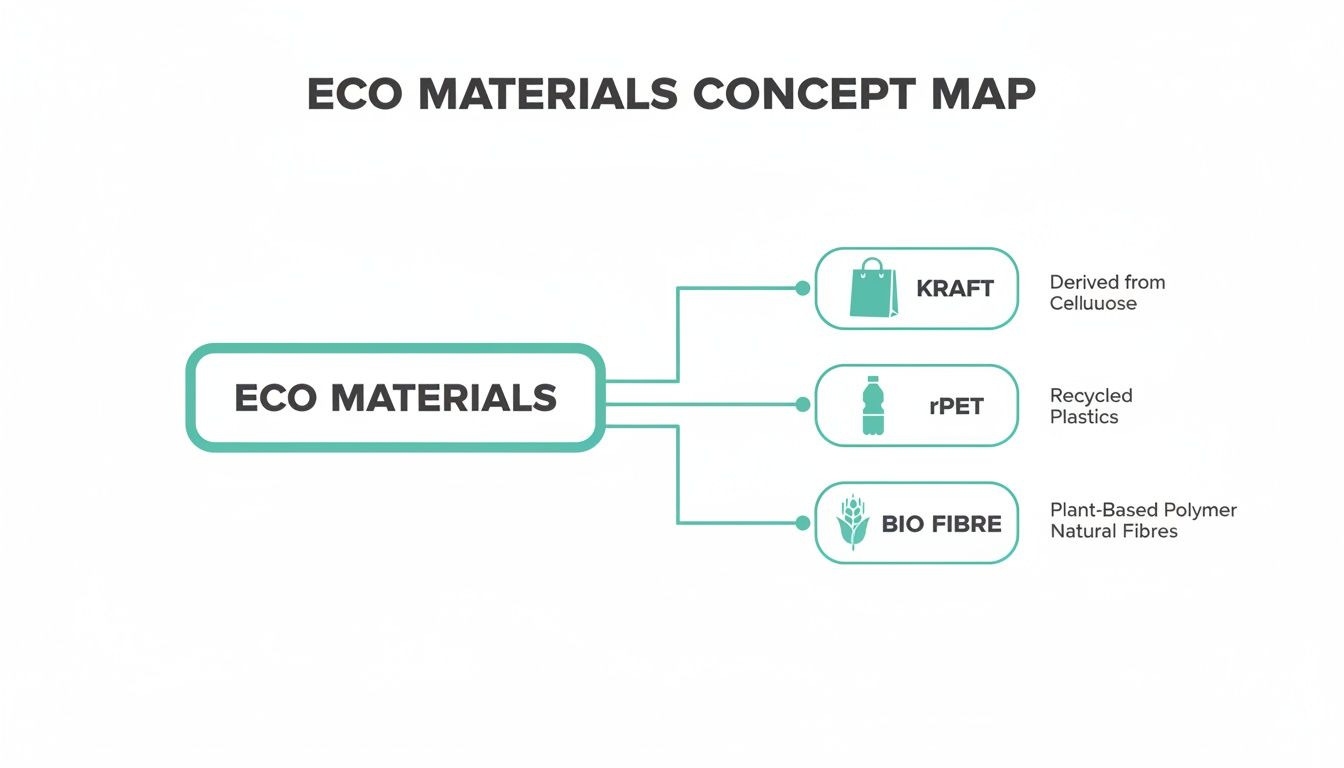
This visual really highlights the diverse sources of today's sustainable materials, from recycled plastics like rPET to brilliant plant-based options like Kraft, PLA, and Bio Fibre.
Why The Small Details Make A Big Difference
Beyond the basic material, it’s the design features that really elevate the performance of your packaging. These are the small, thoughtful details that take the customer experience from just 'okay' to 'excellent'.
Take the humble coffee cup. A single-wall cup might be cheaper, but it needs a separate sleeve to be held comfortably, which adds an extra cost and another item for the customer to juggle. A double-wall cup, however, has that insulation built right in, providing a much more premium and convenient experience. It shows you’ve actually thought about their comfort.
A study by Unilever found that one in three shoppers in the UK actively choose products from companies they believe are doing good things for the environment. High-performance, eco-friendly packaging reinforces that positive choice, proving that sustainability and quality can absolutely go hand-in-hand.
It’s the same with accessories like napkins and straws. A thin, flimsy napkin that tears easily is frustrating, whereas a thick, absorbent one feels like a quality touch. We all remember the early paper straws that turned into a soggy mess, but modern Bio-Fibre straws are designed to be just as durable as their plastic counterparts. They don't go soft, meaning your customer can enjoy their drink right down to the last sip.
By investing in a full range of high-performing eco-friendly takeaway containers, you show a commitment to quality that your customers will definitely notice and appreciate.
Balancing Your Budget: Cost Versus Sustainability
Let’s get straight to it and tackle the elephant in the room: the cost. For most food businesses in the UK, the conversation around switching to sustainable packaging nearly always boils down to one question—is this going to break the bank? There's a persistent myth that going green means going into the red, but the real story is much more nuanced and, honestly, a lot more positive.
Sure, the initial price-per-item for some eco-friendly takeaway containers can be a touch higher than the old-school plastic options. But looking only at the unit price is like judging a meal by the cost of one ingredient. When you zoom out and look at the bigger financial picture, making smart, sustainable packaging choices can actually lead to long-term savings and even give your revenue a healthy boost.
It's better to think of this as an investment in your brand's future, not just another expense on the spreadsheet. Once you start weighing up all the factors, the scales often tip decisively in favour of sustainability.
Unpacking the True Costs and Savings
The price tag on your packaging isn't random; it's shaped by a few key things. Get a handle on these, and you can make some really savvy, cost-effective decisions without ditching your green principles.
First up, material choice is a big one. A straightforward Kraft paper box, for example, is usually going to be kinder to your budget than a more specialised material like bagasse. The trick is to match the material to what your food actually needs. You wouldn't serve soup in a paper bag, and you don't need a heavy-duty, heat-proof container for a cold sandwich. Avoiding over-engineering saves you money.
Next, order volume is a classic cost-driver. It works just like ordering your food supplies – buying in bigger batches brings down the price for each item. Teaming up with a supplier who offers good deals for larger orders, like free delivery or better rates, can make a huge difference to what you spend over a year.
Here are a few practical ways to keep your budget in check:
Dodge the Plastic Taxes: The UK's Plastic Packaging Tax hits any plastic packaging with less than 30% recycled content. By switching to compliant rPET or moving over to paper-based containers, you sidestep that tax completely.
Buy in Bulk: Get your inventory planning down to a fine art and place larger orders less often. Not only will you get a better unit price, but you’ll also cut down on delivery costs and the carbon footprint that comes with them.
Smart Supplier Partnerships: Find a supplier who gets what it's like to run a food business. Services like free storage for bulk orders are a game-changer – you can buy at the lower price point without having to find space for pallets of boxes in your already-cramped stockroom.
It's worth remembering that the market is on your side here. A recent global report found that a massive 82% of consumers are willing to pay more for products in sustainable packaging. This isn’t just a trend; it’s a fundamental shift in how people think. Your packaging is no longer just a cost – it’s a feature that people value and will pay for.
Framing Sustainability as a Marketing Asset
If you're only looking at your eco-friendly packaging as an operational cost, you're missing a massive opportunity. Your containers, cups, and bags are walking, talking adverts for your business. They tell a story about your values with every single order that goes out the door.
Think about it from the customer's point of view. When their meal arrives in packaging that’s clearly been chosen with care, it makes them feel good about their decision to order from you. It creates a positive little moment that they’ll remember and are much more likely to talk about, whether that's to a friend or on their Instagram story. Suddenly, your packaging is actively winning you loyal customers and new ones.
It sends a clear message: you're a modern, responsible business that cares about quality from the moment the food is cooked to the moment it’s eaten. In a crowded market, that kind of thing really makes you stand out. Shout about it on your menu, your website, and your social media. You'll attract that growing crowd of diners who actively look for businesses that share their values. This simple switch in mindset turns your packaging budget into a smart marketing investment that pays for itself by keeping your tables full and your delivery orders flowing.
Using Your Packaging As A Powerful Branding Tool
Think of your packaging as more than just a box to get food from A to B. The moment an order walks out your door, that container, cup, or bag becomes a roaming advertisement for your brand. It’s here that we move beyond pure function and into marketing, looking at how custom printing can turn your eco-friendly takeaway containers into a serious brand-building asset.
Custom-branded packaging pulls everything together, creating a professional look that extends your customer's experience long after they've left your premises. It's a physical reminder of your quality and values, turning a simple meal into something memorable that reinforces who you are.
From Simple Box To Brand Ambassador
Picture the journey your food packaging takes. It's carried down the street, brought into an office, and set down on a kitchen table. A plain, unbranded box gets the job done, sure, but a well-designed one tells a story. It immediately links the delicious food inside with your brand name, making the whole experience feel cohesive and special.
That kind of visual consistency is gold for building brand recognition. When people see your logo on a coffee cup or a takeaway bag, it acts like a quiet endorsement, building curiosity among potential new customers before they’ve even thought about ordering. It’s a deceptively simple way to get noticed in a crowded market.
Getting Started With Custom Branding
Diving into custom printing can feel a bit intimidating, but it’s more straightforward than you might think for UK food businesses. You just need to get your head around a few practical details to make sure the process runs smoothly and looks brilliant.
One of the first things you’ll hear about is the Minimum Order Quantity (MOQ). This is simply the smallest order a supplier will produce in one go. In the past, high MOQs were a real roadblock for many small and medium-sized businesses.
These days, savvy suppliers like Afida have changed the game. We can offer custom branding on items like coffee cups with MOQs starting from just 1,000 units. This puts bespoke packaging within easy reach for independent cafés and takeaways, letting them punch well above their weight and compete with the big chains on branding.
When you're thinking about design, remember that less is often more. A clean, sharp logo and maybe your website or social media handle is all you really need for instant recognition. Just as important is the print quality. A blurry or faded logo can look unprofessional and undermine your brand, so it pays to work with a supplier who guarantees a top-notch finish that matches the quality of your food.
Here’s a quick checklist to guide you through your first custom print run:
Finalise Your Design: Keep it simple. Make sure your artwork is high-resolution for a crisp, clean print.
Confirm MOQs: Check the minimum order for each item you want to brand, whether it's cups, boxes, or napkins.
Request a Proof: Always, always ask for a digital or physical sample to sign off on before the main production starts.
Clarify Lead Times: Get a clear timeline so you know exactly when your branded stock will arrive.
Discuss Storage Options: Got limited space? Ask if your supplier can hold your bulk order and let you call off stock as you need it. It’s a lifesaver for many businesses.
By putting a bit of thought and budget into custom-branded packaging, you’re doing more than just buying containers. You’re investing in a marketing tool that’s out there working for you around the clock, building loyalty and turning every customer into a walking advert for your business.
Your Practical Checklist for Choosing a Supplier
Picking the right partner for your eco-friendly takeaway containers is just as crucial as picking the right materials. A great supplier isn't just a vendor; they become an extension of your team, offering the kind of reliability and support that lets you get back to focusing on your food. This checklist is designed to cut through the noise and help you find a partner who truly gets what your business needs.
Think of this as your final quality check before signing on the dotted line. A few smart questions now can save you a world of pain later.
The Non-Negotiables of Supplier Vetting
Before you even get to pricing, there are a few fundamentals any potential supplier has to nail. These are the things that build a solid, trustworthy relationship and protect your brand's reputation.
Start with the absolute basics:
Verify Certifications: Don't just take their word for it. Ask to see proof of certifications like FSC for any paper or card products. A legitimate supplier will have this on hand and be happy to share it, proving their materials come from responsible sources.
Request Samples: This is a big one. Never commit to a bulk order without getting your hands on the product first. Samples let you see exactly how the containers, cups, and lids perform with your actual menu items. Does that curry leak? Does the coffee lid fit snugly? You need to know.
Confirm Stock Reliability: Ask them straight up about their stock levels and how they manage their inventory. You need a partner who can keep up with your demand, especially when you hit your busiest season. The last thing you want is to run out of containers on a Friday night.
A supplier worth their salt knows that their success is tied directly to yours. They should be one step ahead, offering solutions before you even ask—from sending free samples to test heat retention to advising on the smartest options for your order size.
Logistics and Service Level Questions
Once you’re happy with the product quality and sustainability claims, it’s time to dig into the service and logistics. This is where the day-to-day reality of working with a supplier really shows. Fantastic service can make a massive difference to how smoothly your operation runs.
Here are the key logistical points to get clear on:
Delivery Times and Costs: What are their standard delivery times across the UK? Do they offer free delivery if you spend over a certain amount? A quick, dependable delivery service, like a 48-hour turnaround, is vital for keeping your stock room lean and responsive.
Custom Branding Options: If you’re looking to get your logo on your packaging, you need to ask about Minimum Order Quantities (MOQs), print quality, and lead times. A supplier with a low MOQ can make custom branding a realistic option even for smaller, independent businesses.
Support and Flexibility: How easy is it to speak to a real person? A good partner is responsive, helpful, and easy to reach. For any specific questions or to chat about what your business needs, you should be able to contact their team easily.
Here's a simple table to keep on hand when you're comparing your options.
Supplier Evaluation Checklist
| Evaluation Criteria | What to Ask/Check | Why It Matters |
|---|---|---|
| Product Quality & Sourcing | Can you provide proof of FSC, BPI, or other certifications? | Ensures their sustainability claims are legitimate and protects your brand. |
| Sample Availability | Can you send me free samples of products X, Y, and Z? | Allows you to test performance with your specific food and drink items. |
| Inventory & Reliability | What are your typical stock levels? What's your fulfilment rate? | You need a consistent supply chain that won't leave you in the lurch. |
| Delivery Logistics | What are your standard delivery times and costs? Is there a free delivery threshold? | Predictable and affordable delivery is key for managing operational costs. |
| Minimum Order Quantities | What is the MOQ for standard and custom-branded items? | Determines if their order sizes are a good fit for your business volume and budget. |
| Customer Support | Is there a dedicated account manager or a direct line for support? | You need quick access to help when issues or urgent questions arise. |
| Pricing & Payment Terms | Can you provide a clear price list? What are the payment terms? | Transparency on costs helps you budget accurately and avoid hidden fees. |
By working through this checklist methodically, you can move forward with confidence, knowing you’ve chosen a supplier that doesn't just sell great eco-friendly takeaway containers but also delivers the reliable service your UK food business deserves.
Your Questions on Eco-Friendly Takeaway Containers Answered
Switching to sustainable packaging is a big move for any food business, and it’s completely normal to have questions. You want to do the right thing, but you also need packaging that works for your food, your customers, and your bottom line.
Let's cut through the noise and tackle some of the most common questions we hear from UK hospitality businesses.
Are Eco-Friendly Containers More Expensive?
This is usually the first question on everyone's mind, and the answer isn't a simple yes or no. While the price per unit for some sustainable options might look a bit higher than traditional plastics at first glance, that's not the whole story.
First off, you have to consider the UK’s Plastic Packaging Tax. This tax hits any plastic packaging with less than 30% recycled content, so by choosing materials like paper or rPET, you're already avoiding that extra cost. Plus, buying in bulk and working with a supplier who offers free delivery can make a massive difference to your overall spend.
Think of it less as an expense and more as an investment. Today’s customers actively seek out businesses that care about the environment, and they're often happy to support places that align with their values.
Will They Perform as Well as Plastic?
Absolutely. Long gone are the days of soggy paper boxes and flimsy containers. Modern eco-friendly takeaway containers are designed to be tough, reliable, and performance-driven.
Innovations in materials like bagasse (made from sugarcane pulp) and specially lined Kraft paper mean you get all the benefits—leak-proof, grease-resistant, and sturdy—without the environmental downside of virgin plastic.
Just look at what's possible:
Double-wall paper cups keep coffee piping hot without needing an extra sleeve.
Bagasse clamshells are fantastic for hot, crispy food like fish and chips because they're strong and don't trap steam, preventing sogginess.
Bio-Fibre straws feel just like plastic and, most importantly, won't turn to mush in your customer's drink.
The trick is simply to match the right material to the right dish. That's why we always recommend getting your hands on some samples to test them out with your own menu before you place a big order.
There's a common myth that "eco-friendly" means weak or fragile. The reality is that today's sustainable packaging is built to handle the bumps and knocks of takeaway and delivery, making sure your food arrives looking and tasting exactly as it should.
How Do I Know Which Materials Are Genuinely Sustainable?
This is a great question, as "greenwashing" is a real concern. The simplest way to be sure is to look for official, third-party certifications.
For anything made from paper or card, look for the Forest Stewardship Council (FSC) logo. This is your guarantee that the wood pulp comes from forests that are managed responsibly. For compostable products, you'll want to see certifications like EN 13432, which proves they'll break down properly in an industrial composter.
Any supplier worth their salt will be completely transparent about where their products come from and should be happy to show you the paperwork. This is how you ensure the choices you make are having a genuinely positive impact.
Ready to make the switch with confidence? The team at Afida is here to help you find the perfect eco-friendly packaging for your menu. Explore our full range of high-performance, sustainable solutions at https://afida.com.