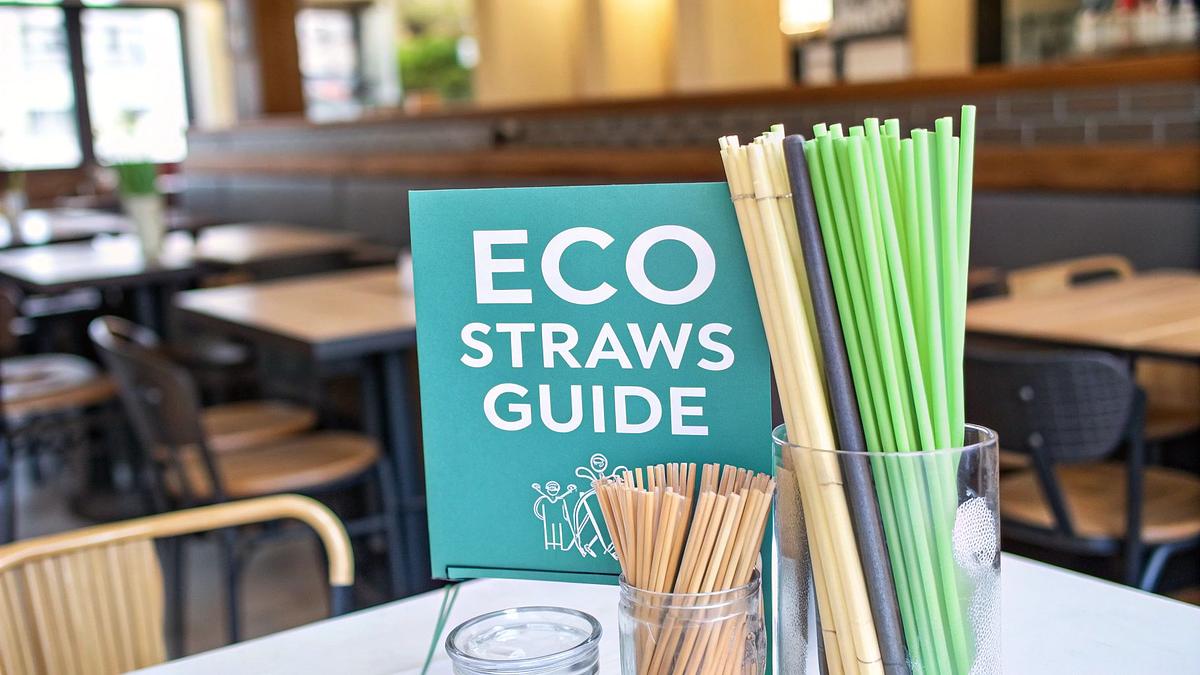
Switching from plastic straws isn't just about 'going green' anymore—for any UK pub, café, or restaurant, it's a fundamental part of running a modern business. The real challenge is finding an alternative that actually works, fits your brand’s sustainability message, and doesn’t break the bank. This practical guide cuts through the noise to help you find the right eco straws and other disposables that improve your customer's experience without creating a headache for your team.
Why Getting Disposables Right is Non-Negotiable
For hospitality businesses across the UK, sustainability is a huge part of building a great reputation. Your customers are more clued-up on environmental issues than ever before, and something as simple as a straw can genuinely influence what they think of you. Offering a decent, eco-friendly alternative shows you’re serious about doing the right thing, not just ticking a box.
This isn't just about looking good, either. It’s a smart business move. The push away from single-use plastics is the perfect chance to look at all your disposables, from coffee cups and takeaway food containers to napkins. Choosing the right eco-straw—like a sturdy Bio Fibre one that won’t turn to mush in a G&T—means your drinks service stays top-notch, all while sending a positive message about your brand.
What’s Driving the Big Switch?
Let's be honest, a lot of this change has been pushed along by new laws. The UK's ban on plastic straws, which fully kicked in back in 2020, was a massive turning point for the entire food and drink industry. It didn't just get rid of an old product; it sparked a wave of new ideas and created a real demand for better, greener options across the board, including cups, containers, and napkins.
This legal shift has had a ripple effect on the economy, too. The market for eco-friendly straws in the UK is growing fast, with experts predicting it will expand at a rate of 7.1% every year between 2025 and 2035. That’s a clear sign of just how quickly the industry is moving. Learn more about the eco-friendly straws market growth.
Adopting eco straws is more than a regulatory tick-box; it's a direct reflection of your brand's values. It tells your customers that you care about the details—both in the quality of your service and your impact on the planet.
At the end of the day, putting a bit of thought into your choice of disposables is a small change that makes a big difference. It protects your reputation, keeps your customers happy, and shows you're a forward-thinking business in a world that’s paying more attention than ever.
A Practical Comparison of Eco Straw Materials
Picking the right eco-friendly straws for your business comes down to a balancing act. You need to weigh up performance, customer experience, your budget, and what's genuinely best for the planet. With so many choices out there, it’s easy to get a bit lost.
Let's cut through the noise and take a practical look at the most common materials on the UK market. This will help you find the perfect match for everything you serve, from fizzy drinks to the thickest milkshakes.
Making this call isn't just about the straw itself. It's about how that choice affects your business – from customer perception and operational performance right down to your bottom line.

As you can see, it's all connected. Your choice of straw sends a message to your customers and has a real impact on your day-to-day operations.
Eco Straw Materials At a Glance
To give you a quick overview, this table breaks down the main contenders. Think of it as a cheat sheet to help you compare the materials side-by-side before we dive into the details.
| Material Type | Best For | Durability in Liquid | Sustainability Profile | Typical Cost |
|---|---|---|---|---|
| Paper | High-volume, budget-conscious venues (cafés, takeaways) | Good (modern versions); can soften over time | Widely recyclable and biodegradable | Low |
| Bio-Fibre | All-purpose use; good for thicker drinks like smoothies | Excellent; holds its structure like plastic | 100% biodegradable and compostable | Low-Medium |
| PLA (Bioplastic) | Cold drinks; venues with access to industrial composting | Excellent; feels just like traditional plastic | Requires industrial composting to break down | Medium |
| Bamboo | In-house reusable option for a rustic, natural feel | Excellent (reusable) | Renewable and reusable; needs proper cleaning | High (initial) |
| Metal | Premium cocktails and in-house drinks (reusable) | Lasts for years; very durable | Highly reusable but energy-intensive to produce | High (initial) |
| Glass | High-end, supervised settings (e.g., fine dining) | Excellent (reusable) but fragile | Reusable and non-porous, but risk of breakage | High (initial) |
Now you've seen the headlines, let's explore what these options mean for your business in a bit more detail.
Single-Use Biodegradable Straws
For most busy cafés, pubs, and takeaways, single-use straws are simply the most practical and hygienic choice. The goal here is to find something that does the job well and then breaks down without leaving a mess for future generations.
Paper Straws: These are often the go-to when a business first ditches plastic. We all remember the early versions that turned to mush in minutes, but things have moved on. Today's high-quality paper straws are built from tougher, food-safe materials that hold their shape for much longer. They’re cheap, easy to get hold of, and simple to dispose of.
Bio-Fibre Straws: If you’re looking for a serious upgrade in durability, Bio-Fibre straws are a fantastic choice. They're made from natural fibres like sugarcane or bamboo pulp and feel almost as sturdy as plastic, but without the environmental baggage. Better still, they are 100% biodegradable and won't leave a papery taste in your customer's drink. We have a more detailed guide on biodegradable straws if you want to learn more.
PLA (Polylactic Acid) Straws: PLA is a bioplastic made from plant starch, usually corn. On the surface, it's a brilliant solution – PLA straws look and feel identical to the old plastic ones. The big "but" is how you get rid of them. They only break down in special industrial composting facilities, which are still few and far between in the UK. If they end up in general waste, they behave a lot like regular plastic.
Reusable Straw Options
Reusable straws are less common for general customer use, mostly because of the practical hurdles of hygiene and logistics. Still, some places make them work, especially for in-house service.
With reusable straws, you're not buying a consumable; you're buying equipment. The upfront cost is higher, and you have to account for the staff time and resources needed to collect, wash, and sanitise them properly to meet food safety standards.
For bars looking to create a more premium feel, a specialist guide on choosing the right cocktail drink straws can provide some really useful insights into different materials.
Bamboo Straws: Made from one of the world's fastest-growing plants, bamboo straws have a great natural, rustic look. They're tough and can be washed and used again and again. The downsides? They can sometimes hold onto strong flavours if not cleaned perfectly and need to be handled with care to avoid splintering over time.
Metal Straws: Usually made from stainless steel, these are the heavy-duty option. A good metal straw can last for years. They are simple to clean and can go straight in the dishwasher. However, they are completely rigid, which some people don't like, and they get incredibly cold in iced drinks, which can be a bit of a shock!
Glass Straws: Glass straws look fantastic – very sleek and elegant. As a non-porous material, they don't hold onto flavours at all. They're a brilliant premium choice, but they are also the most fragile. The risk of breakage in a busy pub or restaurant makes them a non-starter for most commercial venues.
How Eco Straws Perform in a Busy Service Environment
Let’s get straight to the point: will these eco-friendly straws actually hold up during a busy service, or will they just frustrate customers? We all remember the early days of paper straws that turned to mush in minutes. Thankfully, things have moved on a lot since then. The best alternatives on the market today are specifically designed to handle the fast-paced demands of a café, bar, or restaurant.
The real secret is matching the right straw to the right drink. A well-made Bio-Fibre straw or a premium, multi-ply paper straw can easily handle a thick smoothie or a milkshake without collapsing. They’ve also been engineered so they won’t leave a papery aftertaste in a carefully crafted cocktail or fizzy drink. Performance is no longer an afterthought; it’s a core feature.

This focus on quality goes beyond just the straw itself. When a customer gets their order, every little detail matters. A solid, reliable eco straw should feel like a seamless part of the experience, right alongside your branded paper cups, takeaway food containers, and even the napkins you’ve chosen.
Durability and Customer Experience
A straw’s real test isn't the first sip—it’s whether it lasts until the very last one. True durability means maintaining its shape and structure throughout the entire time a customer is enjoying their drink.
The 'mouthfeel' of a straw—its texture and how sturdy it feels—is a subtle but crucial part of the experience. A straw that feels flimsy or goes soft too quickly can spoil an otherwise perfect drink, reflecting poorly on your attention to detail.
Here are a few practical things to think about when picking your straws:
- Hot vs. Cold Drinks: Not every eco straw can handle heat. PLA straws, for instance, are brilliant for iced coffees but will likely warp in a hot chocolate. Premium paper and Bio-Fibre straws tend to be a safer bet for both hot and cold use.
- Carbonated Beverages: The fizz in soft drinks can make lower-quality paper straws break down faster. It's essential to test samples with your own range of sodas to make sure they can go the distance.
- Thick Drinks: Smoothies, milkshakes, and frozen cocktails demand a wider-bore straw with reinforced walls. Trying to use a standard-sized, flimsy straw will only end in frustration for your customers.
Training Staff for a Smooth Transition
Your front-of-house team is key to making the switch to eco straws a success. It’s not just about the product; it’s also about how it’s handled.
Staff should be trained to keep straws in clean, dry dispensers. This prevents them from getting damaged or contaminated before they even get to the customer.
It's also a great idea to give your team a quick rundown on why you chose these particular straws. If a customer mentions the change, your staff can confidently explain that it’s a high-quality, durable alternative you’ve picked to be more sustainable without compromising their experience. This simple bit of communication reinforces your brand’s values and shows you’ve put real thought into every detail.
Understanding UK Regulations and Responsible Disposal
For any hospitality business in the UK, choosing the right eco straw isn't just about how it performs or what it costs. It's about staying compliant and making a genuinely responsible choice for the environment. Navigating the rules while ensuring your efforts actually help the planet means looking beyond the marketing hype and into the practical reality of waste management here in the UK.
The ban on single-use plastic straws was a huge step forward, but the world of alternatives has its own set of challenges. The last thing you want is for your well-intentioned choice to create a new problem, like a "compostable" straw ending up in landfill because it can't be processed correctly. It’s all about understanding the true end-of-life journey for every disposable item you use, from straws and cups to food containers.
Navigating Disposal Realities
One of the biggest points of confusion for operators is the difference between 'biodegradable' and 'compostable'. They sound interchangeable, but for your waste collection, they mean completely different things.
Biodegradable simply means something will break down into natural elements over an unspecified amount of time. Compostable is a certified standard, meaning a product will decompose into soil within a set period but only under specific conditions, usually in a commercial composting facility.
Here’s the catch: access to these industrial composting facilities is patchy across the UK. That PLA straw, which looks and feels like plastic but is certified for commercial composting, becomes a real issue if your local waste service can't handle it. In that all-too-common scenario, it just gets thrown into general waste, completely defeating the purpose.
If you want to get into the nitty-gritty, you can learn more about the critical differences between compostable and biodegradable materials in our detailed article.
Practical Steps for Proper Disposal
To make a choice that's sustainable in practice, not just on paper, you have to match your products to your local waste infrastructure. This is how you ensure your efforts make a real-world difference.
- Check with Your Waste Contractor: This is the single most important step. Before you even think about placing an order, have a straight conversation with your waste management provider. Ask them exactly what types of materials they can and can’t process for composting or recycling.
- Prioritise Simplicity: For a lot of businesses, a 100% biodegradable product like a Bio-Fibre straw is often the most straightforward and genuinely eco-friendly option. It breaks down naturally, so it doesn't rely on specialised, hard-to-access facilities.
- Clear Bin Labelling: Don't leave it to guesswork. Use clear, simple signs on your bins to show staff and customers exactly where straws, cups, and food waste should go.
- Avoid Contamination: A quick chat with your team can make a huge difference. Make sure they understand why keeping waste streams separate matters. A single compostable straw tossed into the plastic recycling can be enough to contaminate the whole batch.
By digging into these details, you can pick eco straws that are not only compliant and great to use but are also verifiably sustainable, from the first sip right through to their final disposal.
Making a Smart Purchase for Your Business
Choosing the right eco-straws isn't just another task on your procurement list; it’s a strategic decision that touches everything from your budget to your brand's reputation. It’s about shifting your mindset from simply looking at the price-per-straw to seeing the bigger picture: performance, customer experience, and operational sense.
Think about it this way: a slightly more expensive, high-quality straw that stands up to a long drink and doesn't trigger complaints is worth far more than a cheap alternative that falls apart and sours a customer's visit. In the UK, where people really care about sustainability, this matters even more. The real challenge is finding a supplier who gets the pressures of a busy bar or café and delivers a product you can trust, service after service.

Analysing Costs and Supplier Reliability
To really get this right, you need to understand the pricing structures that different suppliers offer. A proper cost analysis isn't just about the invoice price. It also accounts for hidden costs, like the waste from a batch of poor-quality straws or the time your team spends apologising for them. That’s the calculation that separates a savvy operator from the rest.
But the numbers are only half the story. Your supplier's reliability is crucial. Before you sign anything, get clear answers to a few key questions:
- Proof of Claims: Can they show you the paperwork? If a straw is 'biodegradable' or 'compostable', they should have the certifications to back it up.
- Stock Security: What’s their plan for keeping you supplied? The last thing you need is to run out of straws on a bank holiday weekend.
- Delivery Promises: Can they guarantee a reliable delivery window, like a 48-hour turnaround? Predictability is key to managing your stock.
Doing this homework upfront protects your day-to-day operations and ensures the straws you're buying are genuinely as green as they claim.
Testing Samples and Streamlining Logistics
Here's a golden rule: never, ever commit to a bulk order without trying the product first. Getting your hands on free samples is a must. It's the only way to see how the straws perform with your drinks—from thick, icy milkshakes to acidic, citrus-heavy cocktails. Check their durability, how they feel, and whether they last the course.
Any supplier who believes in their product will be more than happy to send you samples. It’s the ultimate test to make sure what looks good online actually works perfectly in a customer’s glass.
Your ordering and delivery logistics are just as vital. Look for suppliers offering genuine flexibility, like low minimum order quantities for custom branding. This gives smaller, independent businesses a chance to make their mark without having to buy a pallet's worth.
Smart ordering can also align you with changing customer habits. With the post-2020 plastic ban now firmly in place, UK consumer attitudes have shifted massively—recent data shows 76% are open to using reusable options. This eco-conscious mindset makes having reliable, high-quality straws non-negotiable. To see all the high-performance options available, check out our https://afida.com/categories/straws.
Still Have Questions About Eco Straws?
It's completely normal to have a few last-minute questions, even after you've weighed up the options. Making the right choice for your business is a big deal. To help clear up any lingering doubts, we’ve pulled together the most common queries we hear from hospitality owners across the UK.
Are Modern Paper Straws Really Strong Enough for a Milkshake?
Yes, but with a big caveat: quality is everything. Let's be honest, the first wave of paper straws left a bad taste in everyone's mouth – literally. They went soggy in minutes and pretty much ruined the customer experience.
Thankfully, things have moved on. Today's premium paper and Bio-Fibre straws are engineered completely differently. They're designed to hold their own in thick, ice-cold drinks from the first sip to the last. The key is to source them from a supplier who knows what they're doing. The best advice I can give is to always test samples with your own menu. See how they handle your signature thickshakes and frappes before you even think about placing a bulk order.
What's the Most Cost-Effective Eco Straw?
When you’re looking at single-use options, high-quality paper or Bio-Fibre straws almost always hit the sweet spot between cost, performance, and genuine sustainability. Of course, reusable straws like metal or bamboo have a lower cost-per-use on paper, but that doesn't account for the real-world operational costs. You have to factor in the initial investment plus the ongoing hassle of collecting, washing, sanitising, and eventually replacing them.
Premium paper straws are a solid, affordable choice that keeps you compliant with UK law. More importantly, they’re simple. They fit right into the waste management systems you already have for things like paper cups and takeaway food containers, making life easier for both your staff and your customers.
What’s the difference between ‘biodegradable’ and ‘compostable’? In simple terms, 'biodegradable' just means something will break down naturally over time, but that timeframe isn't guaranteed. 'Compostable', on the other hand, is a certified standard. It means the product is proven to break down into natural elements in a commercial composting facility within a specific period.
The challenge for most UK businesses is that access to these industrial composting facilities is still pretty limited. This is where a 100% biodegradable product, like a Bio-Fibre straw, becomes a really practical and genuinely green choice, as it isn’t reliant on specialised disposal routes.
How Do We Tell Customers About the New Straws?
The best way is to be positive and upfront about it. You’re making a good change, so own it! A small sign at the till, a little note on your menu, or just a quick, friendly mention from your team can make all the difference. It frames the switch as a positive step you're taking together.
Keep the message short and sweet. Something like:
- "We've switched to premium biodegradable straws to help cut down on plastic."
- "They're much stronger and better for the planet!"
- "Enjoy your drink with our new eco straws – we picked them for quality and sustainability."
And if you go for custom-branded straws, your commitment to the environment becomes a visible part of your brand with every single drink you serve. It subtly reinforces your values without you having to say a thing. Remember, every disposable item, from your napkins and takeaway containers to your cups, tells a part of your brand's story.
Ready to serve your customers with premium, reliable eco straws they'll actually like? At Afida, we specialise in high-performance paper and Bio-Fibre options built for the realities of UK hospitality. Request your free samples today and find the perfect sustainable solution for your business. Explore our range of eco-friendly straws on afida.com